What a Timeframe Actually Is
In "Reading a Price Chart" (Lesson 6), you learned how candlesticks compress price data into OHLC bars. A timeframe determines how much time each bar represents.
A 5-minute candle takes every trade that happened in a 5-minute window and compresses it into one open, high, low, and close. A daily candle does the same thing for an entire trading session. The underlying price data is identical. The only difference is the aggregation period: how much time gets packed into each bar.
Think of it like Google Maps. Street view shows you every pothole, every parked car, every crack in the sidewalk. Useful if you're walking. Zoom out one level and you see the neighborhood layout, the main roads, the intersections. Zoom out to satellite view and you see the highway system connecting entire regions. You're looking at the same city at every zoom level. The data didn't change. But the decisions you can make from each view are completely different. Street view tells you which sidewalk to walk on. Satellite view tells you which highway to take. A chart timeframe works the same way.
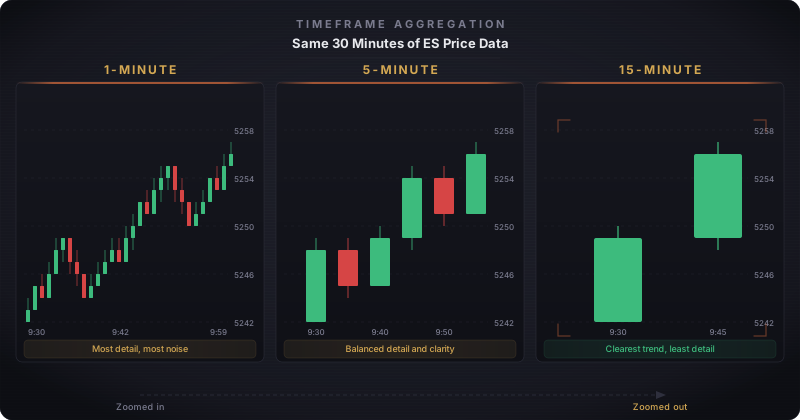
This is why two traders can look at the same market and reach opposite conclusions. One is zoomed into the 1-minute chart watching every tick. The other is looking at the daily chart and sees a clear uptrend. Both are correct about what they're seeing. They're just seeing different slices of the same data.
Noise vs Signal: The Trade-Off
Here's the practical problem: the lower you go, the more noise you see.
Noise is random, short-term price fluctuation that doesn't reflect a meaningful directional move. On a 1-minute chart, price bounces around constantly. Candles form fast, small reversals look dramatic, and every move feels urgent. But most of those moves are just the normal back-and-forth of buyers and sellers negotiating in real time.
Higher timeframes filter that noise. A 15-minute chart smooths out the minor fluctuations and shows you clearer directional movement. A daily chart smooths it even further. The trend that was invisible in the 1-minute chaos becomes obvious when you zoom out.
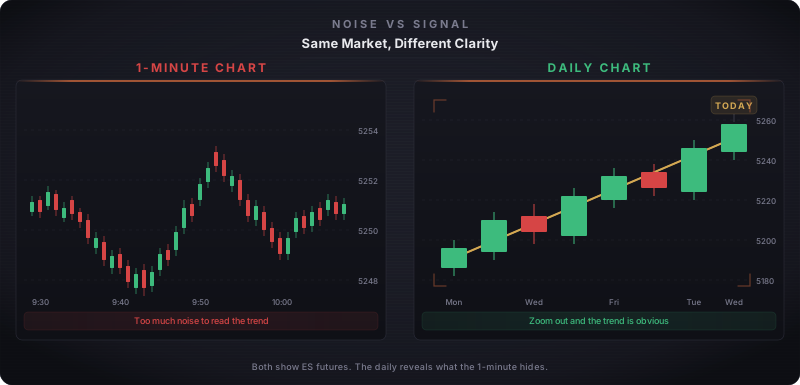
This doesn't mean lower timeframes are useless. Day traders need them for precise entry timing. But if you're making directional decisions based on a 1-minute chart, you're reacting to noise, not signal. That's where many new traders get stuck: they see a 1-minute pullback, panic, and forget the 15-minute chart is still pointing up.
Why Common Timeframes Matter More Than Others
Not all timeframes are created equal. The daily chart, the 1-hour chart, the 15-minute chart, and the 5-minute chart are the most widely used timeframes in futures trading. That popularity itself creates an edge.
When thousands of traders all watch the same 15-minute chart, they see the same support and resistance levels. When price reaches a level that's visible on the 15-minute, many of those traders place orders there: some to buy, some to sell, some to take profit. That concentration of orders makes the level more likely to produce a reaction. The level becomes partially self-fulfilling because so many participants are watching it.
A level visible only on the 1-minute chart? Far fewer eyes on it. Fewer orders concentrated there. Less likely to hold.
This is why the daily chart matters even if you never hold a trade overnight. The levels and trends visible on the daily are the ones that institutional traders, swing traders, and the algorithmic market makers from Lesson 2 are all watching. Those are the participants with the most capital. When they act at a level, it moves price.
The most commonly used primary timeframes for ES/NQ day trading are the 5-minute and 15-minute charts. Higher-timeframe context is typically drawn from the 1-hour and daily charts. These are the default chart configurations across NinjaTrader, TradingView, and thinkorswim, and the timeframes referenced most frequently in institutional futures research.
Common Timeframes and When to Use Them
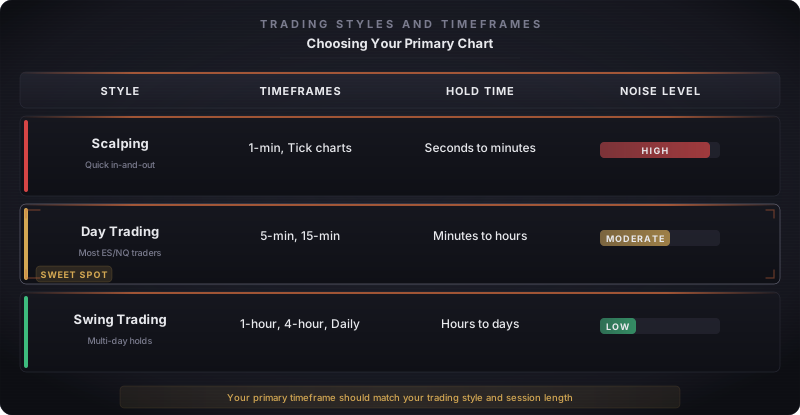
Different trading styles call for different levels of zoom:
Scalping (seconds to minutes): 1-minute and tick charts. Maximum detail, maximum noise. Scalpers need this granularity because they're in and out of trades within minutes. But the noise level makes this the hardest approach for newer traders.
Day trading (minutes to hours): 5-minute and 15-minute charts. This is the sweet spot for most futures day traders. Enough detail to time entries and exits, but the noise is manageable. Most ES and NQ day traders live on one of these two timeframes.
Swing trading (hours to days): 1-hour, 4-hour, and daily charts. Swing traders hold positions overnight or for multiple days. They need less intraday detail and more trend clarity.
A note on tick charts and range bars. Some futures traders use tick charts (each candle represents a set number of trades, like 1,000 trades per candle) or range bars (each candle represents a fixed price range, like 2 points per candle) instead of time-based charts. These exist, and you may encounter them. They compress data differently: by activity or by movement rather than by time. This course uses time-based charts because they're universal, easier to learn, and what most traders reference. If you explore tick or range charts later, the OHLC reading skills from "Reading a Price Chart" (Lesson 6) still apply.
Your primary timeframe should match your trading style and how long you plan to hold a trade. If you're day trading ES during the morning session, a 5-minute or 15-minute chart gives you the information you need. You don't need to watch every tick on the 1-minute chart, and doing so usually creates more anxiety than clarity.
Most beginners think that checking more timeframes means doing better analysis. It feels productive. You're looking at more data, considering more angles, being more thorough. But here's what actually happens: you already have a trade idea, the 15-minute chart doesn't support it, and now you're scrolling through lower timeframes until one of them shows something that looks like confirmation. That's not analysis. That's shopping for agreement. The reason this trap is so effective is that it disguises rationalization as research. Real multi-timeframe analysis starts with the higher timeframe setting direction before you have a trade idea, not after.
Multi-Timeframe Analysis
The most practical use of timeframes isn't picking one and ignoring everything else. It's using two: a higher timeframe for direction and a lower timeframe for timing.
Here's how it works. Say you want to day trade ES. You pull up the daily chart and see a clear uptrend. That's your directional bias: look for longs, not shorts. Then you drop to your 15-minute chart and look for spots where price pulls back to a support level and shows signs of continuing the uptrend. The daily chart tells you where the market is heading. The 15-minute chart tells you when to get in.
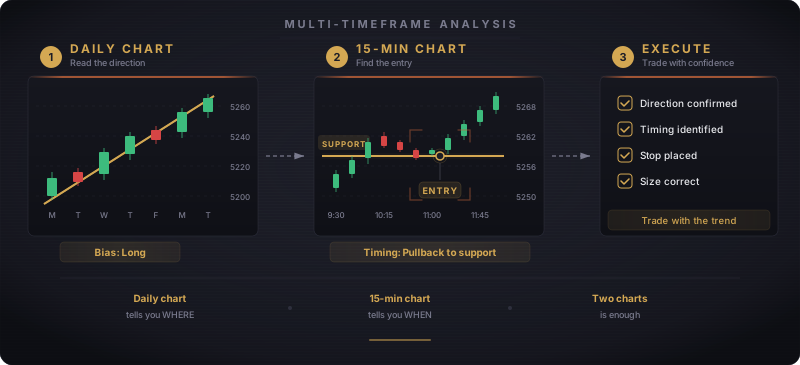
You don't need six monitors running six timeframes. Two is enough for most traders: one higher timeframe for context, one lower timeframe for execution.
You see choppy back-and-forth action. 14 green candles, 16 red candles. Four small reversals. Feels like the market is directionless. Verdict: confusing, no clear trend.
The first three candles are green with growing bodies. The fourth is a small red pullback. The fifth and sixth are green again. Verdict: uptrend with one pullback.
Two large green candles, both with small wicks. Verdict: clear, strong uptrend with buyer control.
The same 30 minutes told three different stories depending on the lens. The 1-minute chart showed noise. The 5-minute showed a trend with nuance. The 15-minute showed clean directional movement. None were wrong. The question is which one helps you make better trading decisions for your style.
This connects to the core idea behind this course. You're building skills at a scale where mistakes teach you instead of overwhelming you. Starting with one primary timeframe and one reference timeframe keeps your process simple enough to actually learn from each trade. Adding more timeframes before you've mastered two just adds confusion.
The next lesson, "Volume: The Market's Footprint" (Lesson 8), covers the data layer that tells you how much conviction is behind each price move you see on your chart. Timeframes show you what price did. Volume shows you how seriously to take it.