What the Economic Calendar Tracks
The economic calendar is a schedule of government data releases, central bank decisions, and other scheduled events that affect financial markets. These aren't surprises. They happen on published dates, at published times, every single month. The dates are known months in advance. The only unknown is the number itself.
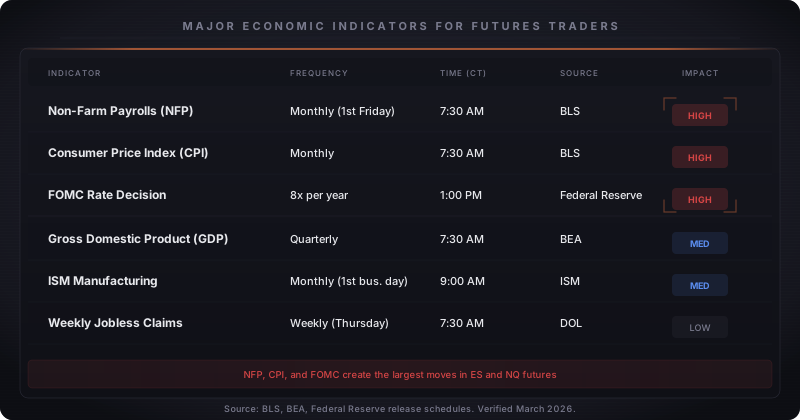
The releases that matter most for futures traders fall into a few categories: employment data, inflation data, central bank decisions, and growth indicators. The chart below shows the major ones with their frequency, timing, and impact level.
Employment data tracks the health of the job market. Non-Farm Payrolls (NFP) is the single most-watched number. Weekly jobless claims provide a more frequent pulse check. When these numbers surprise, the market reacts fast.
Inflation data measures how quickly prices are rising. The Consumer Price Index (CPI), Producer Price Index (PPI), and Personal Consumption Expenditures (PCE) index are the key monthly releases. PCE is the Federal Reserve's preferred gauge. Inflation surprises drive some of the biggest moves in ES and NQ.
Central bank decisions are the heavyweights. The Federal Open Market Committee (FOMC) announces interest rate decisions roughly every 6 weeks. The statement, press conference, and dot plot that follow can move markets for days.
The dot plot is the Fed's published chart showing where each FOMC member expects interest rates to be in the future. Each "dot" represents one member's projection. Markets parse the dot plot intensely because it signals the direction of future rate policy. If the dots shift higher than expected, it means the Fed is thinking about keeping rates elevated longer, which typically pressures equities. If the dots shift lower, it signals rate cuts ahead, which is usually bullish for stocks and stock index futures. You don't need to become a Fed analyst, but you need to know the dot plot exists, because the market will react to it.
Growth data like Gross Domestic Product (GDP) and ISM Manufacturing give a snapshot of economic momentum. These tend to cause smaller moves than NFP or CPI, but they still shift sentiment.
When you open an economic calendar (TradingView, ForexFactory, or Investing.com all have free ones), you'll see three columns that matter: Previous, Consensus (or Forecast), and Actual. Previous is last month's reading. Consensus is what economists expect this time. Actual gets filled in at release time. The number that moves the market isn't any of these individually. It's the gap between consensus and actual.
If CPI consensus is 3.5% and the actual prints at 3.2%, the 0.3% gap is what drives the reaction. Calendars also color-code events by impact level (red/high, orange/medium, yellow/low). For your purposes, focus on the red events. Those are the ones that can move ES and NQ 10 or more points in seconds.
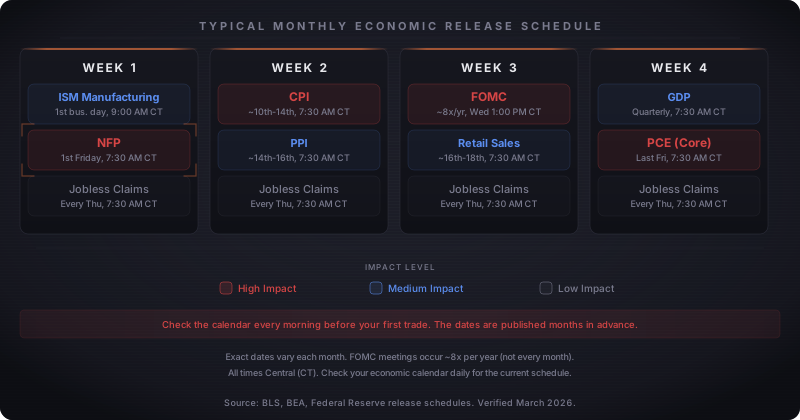
These releases follow a predictable monthly rhythm. Knowing the general schedule means you can plan your trading week before it starts rather than reacting to events you didn't see coming.
Earnings: The Calendar You Forgot to Check
Standard economic calendars track government data and central bank events. But there's another category of scheduled events that moves index futures just as hard: earnings reports from major companies.
ES tracks the S&P 500. NQ tracks the Nasdaq 100. When the largest components of those indices report quarterly earnings, the index futures move, sometimes violently.
The five largest NQ components by market cap (as of early 2026: AAPL, NVDA, MSFT, AMZN, META) collectively make up a significant percentage of the index's weighting. When a top component reports earnings after the close and beats expectations by a wide margin, NQ futures can gap up 100+ points by the next morning's open. When a mega-cap name misses, the overnight session reacts immediately. The specific names at the top of the index shift over time, but the dynamic doesn't change: the biggest names have outsized influence.
These events don't appear on standard economic calendars like ForexFactory. You need to check a separate earnings calendar (your broker likely has one, or use a site like Earnings Whispers or the Nasdaq earnings calendar). During earnings season (roughly 3 to 4 weeks each quarter, starting in January, April, July, and October), major tech earnings are as important as any government data release.
During earnings season, add a second step to your pre-market routine: after checking the economic calendar, check the earnings calendar. Are any top-10 NQ or S&P 500 names reporting today or after yesterday's close? If so, be aware that futures may gap or show unusual volatility at the open.
How News Moves Price
Here's the part most beginners get wrong: price doesn't move because of the number. Price moves because of the surprise, the gap between what the market expected and what actually happened.
Before every major release, economists publish forecasts. The market prices in those expectations ahead of time. When the actual number lands, price moves based on the gap between what was expected and what actually happened.
If CPI is expected at 3.5% and prints at 3.2%, that's a dovish surprise: inflation came in lower than expected. If NFP is expected at 180,000 jobs and prints at 250,000, that's a hot labor market surprise. The direction of the move depends on whether the surprise changes the market's assumptions about interest rates, growth, or risk.
CPI year-over-year: 3.5%
CPI year-over-year: 3.2%
0.3% below expectations = dovish surprise (inflation lower than feared)
Lower inflation = less pressure on the Fed to keep rates high = more likely rate cuts sooner
Initial spike higher as traders price in a more accommodative Fed path
The 3.2% reading means nothing in isolation. It's the gap from the 3.5% expectation that drives the reaction. If CPI had been expected at 3.0%, that same 3.2% reading would be a hawkish surprise, and ES would likely drop.
During major releases, three things happen simultaneously:
- Spreads widen. Market makers pull their orders to avoid getting hit by the initial spike. The bid-ask spread on ES might jump from 1 tick to 4 or more ticks. Remember what you learned in Lesson 5: that wider spread is a direct cost to you on every entry and exit.
- Volume spikes. A flood of orders enters the market as traders react. The first few seconds can see more volume than the previous hour. This is the kind of volume spike you learned to identify in Lesson 8, except it's driven by a known catalyst.
- Price moves fast. ES can move 10 to 20 points in seconds on a major surprise. If you're in a position without a plan, that move is hitting your P&L in real time. A 10-point move on 1 ES contract is $500. In seconds.
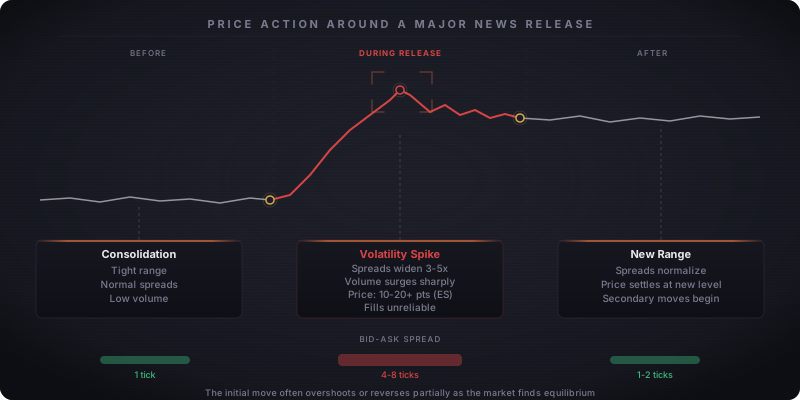
Think of it like opening a pressure valve. Before the release, the market is coiled: traders are positioned, orders are stacked, and everyone is waiting. The number drops and the valve opens. Everything happens at once. Spreads blow out, volume surges, price jumps. Then, over the next 5 to 15 minutes, the market finds a new equilibrium. The initial move often overshoots or reverses partially as the first reaction gives way to more measured positioning.
Using the Calendar in Your Trading Day
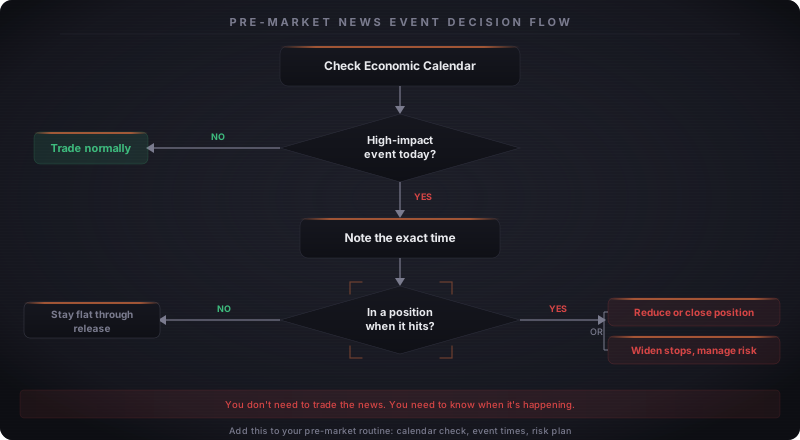
You don't need to trade news events. Plenty of consistently profitable traders go flat before every major release and only trade after the dust settles. That's a valid approach, and it's the approach I'd recommend for anyone working through this module.
Most beginners think they need to trade news events to make money. The reasoning feels logical: NFP just dropped, ES moved 15 points in seconds, and someone just made a fortune. If you could predict the direction, you'd be rich by lunch. That's why the misconception sticks. It looks like the biggest opportunity of the day.
What actually happens is very different. News-driven moves are dominated by algorithms that react in milliseconds, institutional traders with pre-positioned hedges, and market makers who widen spreads to protect themselves. By the time you see the number and decide what to do, the first move is already over. You're not competing with other retail traders in that moment. You're competing with systems built to exploit exactly this scenario. The edge for a new trader isn't in trading the news. It's in knowing when news is coming so you can manage your risk around it.
The bottom line: you don't need to trade news events to make money. You need to know about them to avoid getting destroyed.
Knowing that NFP drops at 7:30 AM CT on Friday means you can plan for it. You can decide in advance whether you'll sit out, reduce your position size, or widen your stops. The decision is yours. The mistake is not making one at all.
This ties into the Pre-Execution Protocol. Before every trade, you check three things: position size, stop placement, and directional bias. In addition to those three checks, the economic calendar adds a question to your morning routine: is there a high-impact event today, and if so, when? This isn't officially part of the Protocol's three steps, but it's the natural pre-session context that makes those three checks more informed.
A simple pre-market routine:
- Every morning, open an economic calendar before your first trade
- Identify any high-impact events and note the exact time
- During earnings season, check the earnings calendar for major tech names
- Decide your plan for each event before the session starts
- If you're in a position when the event approaches, know your exit plan
What You've Built in Module 1.1
This lesson wraps up Module 1.1: How Markets Work. Over ten lessons, you've built a foundation of specific, practical skills that everything else in this course rests on.
Look at what you can do now that you couldn't do ten lessons ago:
You understand market mechanics. You know what a market is (Lesson 1), who the participants are and how exchanges work (Lesson 2), how different market types work (Lesson 3), how orders flow from your screen to the exchange (Lesson 4), and what the bid-ask spread costs you on every trade (Lesson 5).
You can read a price chart. You know how OHLC data maps to candlestick anatomy (Lesson 6), what different timeframes reveal about the same price action (Lesson 7), and how to gauge the conviction behind a move using volume (Lesson 8).
You know when to trade. You understand the three sessions and their personalities (Lesson 9), where volume concentrates during the day, and which scheduled events create the biggest volatility (this lesson).
These skills connect. When you see a breakout on a 5-minute chart during RTH, you can now assess it from multiple angles. Is volume confirming the move (Lesson 8)? What session are you in (Lesson 9)? Is there a news event in 10 minutes that could reverse everything (Lesson 10)? What's the spread costing you (Lesson 5)?
None of this makes you a trader yet. But it gives you the vocabulary, the mental models, and the observational skills to understand everything that comes next.
Take a moment to reflect: which lesson in this module surprised you the most? Which concept did you already know but hadn't thought about carefully? Write down the one idea from Module 1.1 that changed how you think about markets. That's the seed for your trading foundation.
Module Capstone Exercise
Before moving to Module 1.2, complete this observation exercise. It ties together everything from the last ten lessons into a single session of active watching.
Watch one full RTH session (8:30 AM to 3:00 PM CT) on ES or NQ. You don't need to trade. Pull up a 5-minute chart with volume bars visible, and observe the following:
- Session open behavior (8:30 to 9:00 AM CT): How does price react in the first 30 minutes? Is there a clear direction, or does it chop back and forth? How does volume compare to the rest of the day? (Lessons 8 and 9)
- Candle reads: Identify at least 3 candles that tell a story. A long wick rejecting a price, a wide-body candle with conviction, a doji showing indecision. Write down what each candle told you about the battle between buyers and sellers. (Lesson 6)
- Volume confirmation or rejection: Find at least one move (a breakout, a reversal, or a trend push) and assess the volume behind it. Did volume confirm the move, or did it diverge? (Lesson 8)
- News awareness: Did any scheduled economic events occur during the session? If so, how did price and volume behave around the release time? If not, were there any non-scheduled events (headlines, earnings) that caused a reaction? (Lesson 10)
- Session rhythm: Note the midday lull and the afternoon push. Did they show up? How was the energy different from the open? (Lesson 9)
Write a 1-paragraph summary of what you observed. Think of it as practice at watching markets with informed eyes instead of blind ones.
What Comes Next
Module 1.2 covers price action and chart reading in depth. You'll build on the candlestick basics from Lesson 6 to read support, resistance, trends, and the patterns that institutional traders use to trap retail positions. The mechanical foundations from this module (how orders work, what the spread costs, when volume shows up, when news hits) inform every price action concept you'll encounter next. The better you understand these mechanics, the faster everything in Module 1.2 will click.