What the Bid and Ask Actually Mean
In the last lesson, you saw the order book: buyers stacked on one side, sellers on the other. The bid is the highest price any buyer is currently willing to pay. The ask (sometimes called the offer) is the lowest price any seller is currently willing to accept. The bid-ask spread is the gap between those two numbers.
Every participant in the order book is trying to get the best deal they can. Buyers want to pay as little as possible, so bids stack from the highest price downward. Sellers want to receive as much as possible, so asks stack from the lowest price upward. The spread is the no-man's-land where neither side is willing to meet yet.
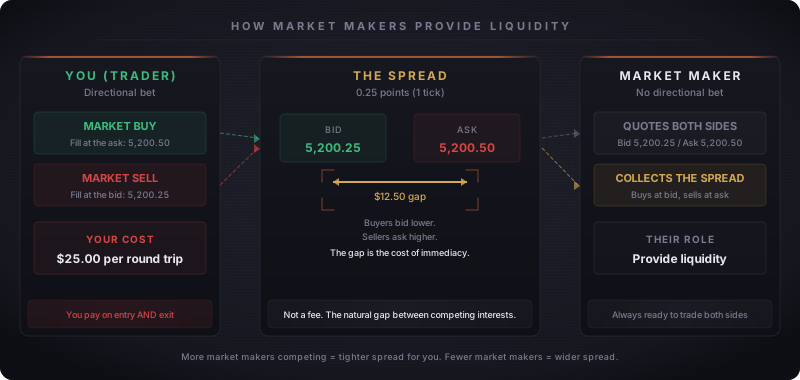
When you send a market buy order, you fill at the ask. When you send a market sell order, you fill at the bid. Every market order you place automatically costs you the width of the spread.
Here's a concrete example. ES is showing a bid of 5,200.25 and an ask of 5,200.50. The spread is 1 tick (0.25 points). If you buy at the ask and immediately sell at the bid, you lose $12.50 per contract without price moving at all. That's not a loss from being wrong about direction. That's the cost of immediacy.
Think of it like exchanging currency at an airport. The booth buys your euros at one rate and sells them at a slightly higher rate. The difference is their profit and your cost. You could get a better rate if you waited and found someone willing to trade directly with you at the midpoint, but you'd have to wait, and you might miss your flight. The spread is the price of not waiting.
Most beginners think the spread is a fee the exchange charges. It feels that way because you lose money the instant you enter a trade. But nobody pocketed that fee. It emerged naturally from the gap between what buyers will pay and what sellers will accept. That distinction matters: fees are fixed and predictable. The spread is not. It changes constantly, and those changes tell you something about the market.
Who's on the Other Side: Market Makers
Every trade needs two sides. When you click "buy," someone has to sell to you. But who? In a liquid market like ES, it's not always another trader making a directional bet. Often, it's a market maker.
Market makers are firms (and sometimes individuals) that continuously post both bid and ask orders in the book. They're not betting on direction. They're providing liquidity, ready to buy from you when you sell and sell to you when you buy. Their profit comes from the spread itself: they buy at the bid and sell at the ask, collecting the gap on each cycle.
This answers the question from the last section: does a limit order pay the spread? No. When you post a limit order at the bid, you're doing what market makers do: providing liquidity, joining the queue of buyers, and waiting for a seller to come to your price. You don't cross the spread because you're not demanding immediate execution. The trade-off is your order might not fill at all.
This is also why liquid markets like ES have such tight spreads. Dozens of market-making firms compete for order flow. Each one tries to post the best (narrowest) bid and ask to attract trades. More competition between market makers means a tighter spread for you.
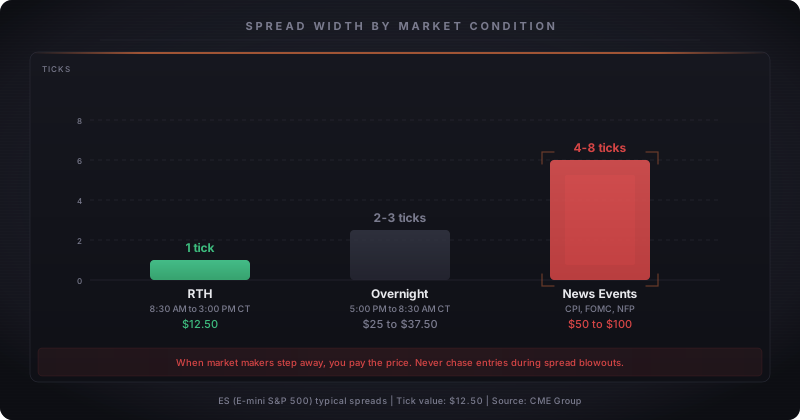
When market makers step away, the spread widens. Nobody is charging more. There's just fewer participants willing to quote prices close together. This is exactly what happens during news events, overnight sessions, and on thinner contracts.
Think of market makers as 24-hour convenience stores. You could buy the same item cheaper at a grocery store, but it's closed and you need it now. The convenience store charges a small markup for being available whenever you walk through the door. Market makers work the same way: always quoting, always ready to trade, and the spread is their markup for providing that availability.
Why the Spread Changes
The spread isn't fixed. It moves throughout the day based on how many participants are actively quoting prices. More participants competing means a tighter spread. Fewer participants means a wider spread. Three factors drive that consistently: time of day, market events, and the contract you trade.
Time of day is the biggest factor. During regular trading hours (8:30 AM to 3:00 PM CT for the most active window), ES typically holds a 1-tick spread because volume is high and hundreds of participants are competing for fills. During overnight sessions (5:00 PM to 8:30 AM CT), many of those participants step away. Fewer resting orders means wider gaps. A 2-tick or even 3-tick spread on ES overnight isn't unusual.
News events cause the book to thin out fast. Before a major release like CPI, FOMC, or Non-Farm Payrolls, market makers pull their orders to avoid getting caught on the wrong side of a sudden move. The spread can blow out to 4-8 ticks on ES in the seconds surrounding a release. If you're sending a market order into that environment, you're paying 4-8 times the normal cost.
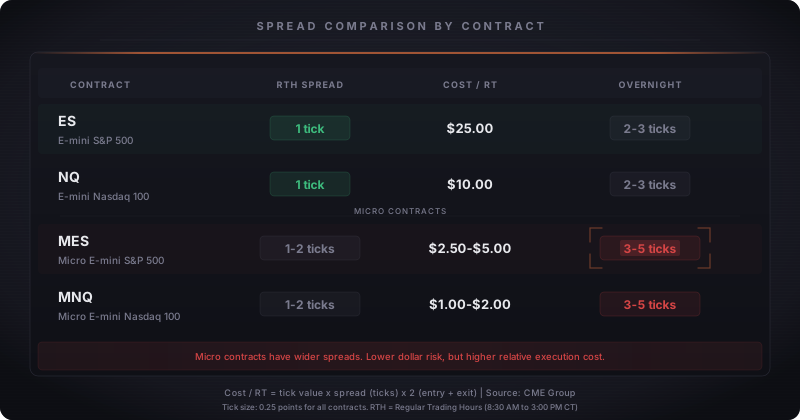
The contract you trade matters too. ES and NQ are among the most liquid futures contracts in the world, so their spreads stay tight. Micro contracts (MES and MNQ) trade with significantly less volume. MES often shows a 1-2 tick spread during regular hours and can widen to 3-5 ticks overnight.
This connects to why we start on micro contracts. Trading micros keeps your dollar risk small while you build skills, and that's the right priority. But know that you're paying relatively more in spread costs per trade on MES. As your skills grow and you move from MES to ES, you don't just get bigger moves. You get cheaper execution.
How Spread Costs Add Up
One tick on ES is $12.50. That doesn't feel like a big deal on any single trade. But you pay the spread on every entry and every exit, and the math gets uncomfortable fast.
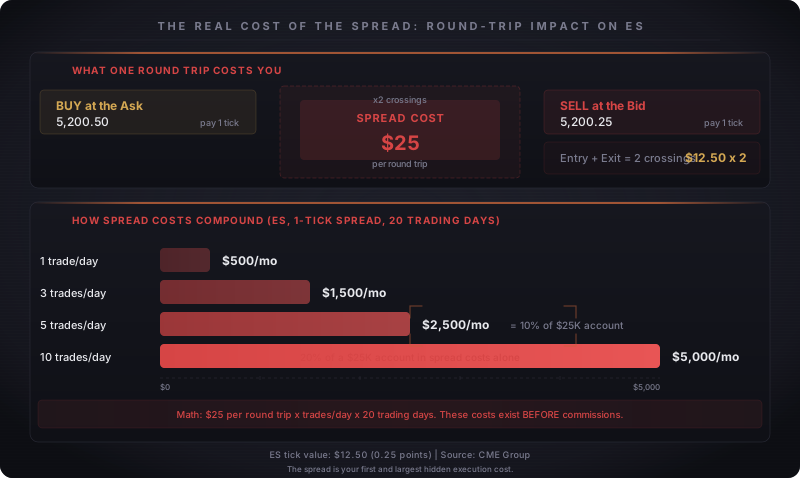
A single round-trip trade on ES during regular hours costs you the spread twice: $12.50 on entry, $12.50 on exit, $25 total. Take 5 round trips a day and you're paying $125. Over 20 trading days, that's $2,500 per month in spread costs alone, before commissions even enter the picture.
0.25 points x $50/point x 2 (entry + exit) = $25.00
$25 x 3 = $75/day = $1,500/month
$25 x 5 = $125/day = $2,500/month
$25 x 10 = $250/day = $5,000/month
At 5 round trips per day on ES, the spread alone costs $2,500/month. On a $25,000 account, that's 10% of your capital every month just in spread costs, before a single commission dollar. On a $50,000 prop firm account, it's 5%. The math is the same: the more you trade, the more the spread eats.
Now change one variable. Switch from ES ($50/point) to NQ ($20/point):
NQ round-trip spread cost = 0.25 points x $20/point x 2 = $10.00
At 5 round trips per day: $10 x 5 = $50/day = $1,000/month
Same frequency, 60% lower spread cost. The contract you trade changes the math significantly. But before you celebrate: NQ moves faster than ES, and those wider intraday swings mean your stops might be wider too. Lower spread cost doesn't automatically mean cheaper trading.
Scalpers get hit the hardest. Ten to fifteen round trips a day means $250 to $375 in daily spread costs on ES. That's $5,000 to $7,500 per month. If your average profit per trade is $50 to $75, the spread is eating 30-50% of your gross profits before you've paid a single commission.
This doesn't mean you should avoid trading. It means your strategy needs to account for these costs. A setup targeting 8 points on ES ($400 per contract) can absorb a 1-tick spread without breaking a sweat. A setup targeting 2 points ($100 per contract)? The spread just ate 25% of your potential profit before the trade even started. The tighter your targets, the more the spread matters.
Now that you can calculate what the spread costs you per trade, per day, and per month, the next lesson shifts to reading what all this buying and selling produces on your screen: price charts. You'll learn how four numbers per candle (open, high, low, close) tell you who controlled each time period and where they lost control.