How Price Gets Discovered
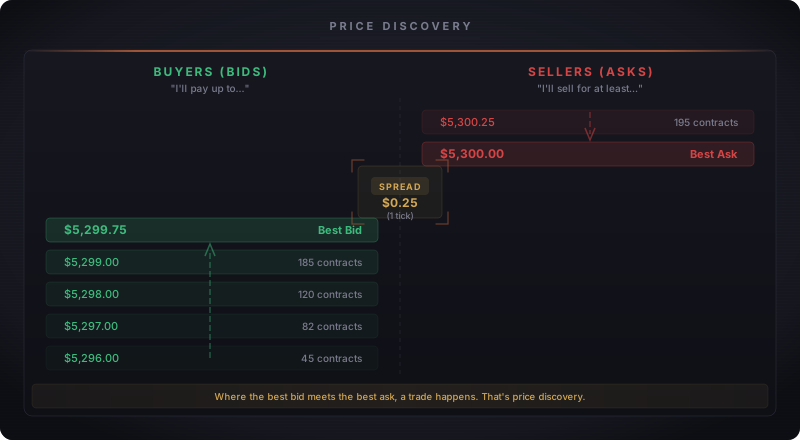
Picture a limited-release sneaker drop on a resale marketplace. The shoe retails for $180, but only 5,000 pairs exist. Within hours, sellers list them at $350, $400, $500. Buyers start placing bids at $250, $280, $300. The first transaction happens at $320, when a seller accepts a buyer's bid. Then another at $325. Then $310 as more sellers list their pairs. The "price" of that shoe isn't set by the company. It's set by every buyer and seller competing to make a deal.
That's price discovery. It's happening right now, on your chart, thousands of times per second.
When you see ES tick from 5,250.00 to 5,250.25, that's not some algorithm deciding the "right" price. That's a buyer willing to pay 5,250.25 because no seller would fill them at 5,250.00. Someone blinked. Price moved.
The sneaker marketplace and the CME use the same mechanics: bids, asks, and a price that shifts based on who wants what and how badly. The difference is speed and scale. On the sneaker marketplace, a listing might sit for hours before someone bites. On ES futures, that same negotiation plays out thousands of times per second.
A single busy session can process over a million contracts, each one a buyer and seller agreeing on a price at that exact moment. But the principle is identical: price is an output of competing intentions, not a number that falls from the sky.
Why Price Moves (and What Doesn't Cause It)
Strip away every indicator, every oscillator, every moving average. Price moves for exactly one reason: an imbalance between supply and demand at the current level.
When there are more aggressive buyers than available sellers, price goes up. Buyers have to bid higher to find someone willing to sell to them. When sellers overwhelm buyers, price drops. Sellers have to offer lower prices to find someone willing to buy.
That's it. That's the entire engine.
Here's a misconception that traps nearly every beginner: indicators cause price to move. They don't. Your RSI didn't move price. Your MACD crossover didn't move price. A real human (or algorithm acting on real orders) decided to buy or sell with enough size to push price past the available orders at the current level. Indicators are math applied after the fact. They describe what already happened. They don't cause anything.
This feels counterintuitive because indicators visually align with past moves, creating an illusion of causation. When RSI hits 70 and price reverses, it looks causal. But the RSI hit 70 because price already moved up aggressively. The indicator was describing the move, not creating it. Confusing description with causation is one of the most expensive mistakes a new trader can make.
Most new traders get this backwards. They stack five indicators on a chart, wait for all five to "confirm," and then wonder why they still lose. The indicators were never the point. The supply and demand imbalance was the point, and it happened before your indicator even updated.
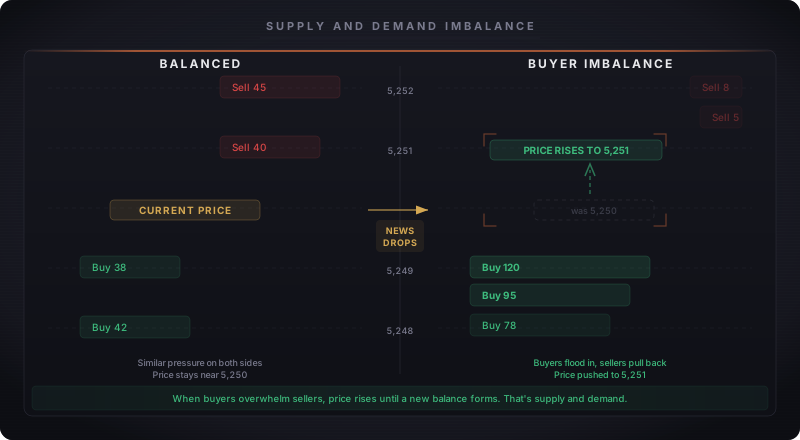
Watch what happens when this goes wrong. Price spikes up on a morning candle, big and green, and it "looks bullish." A new trader buys at the top of that spike because the color of the candle felt like a signal. But that spike was the result of aggressive buyers running out of steam.
The sellers who were waiting at higher prices step in, and price reverses. The new trader panics, sells at a loss, then watches price do the same thing an hour later and makes the same mistake again.
That's not trading. That's reacting to colors on a screen. The spike looked bullish, but the supply and demand picture told a different story: buyers had exhausted themselves, and sellers were sitting right above.
Once you start reading price action as supply/demand imbalances instead of "green means go," you stop chasing and start anticipating. Every bar on your chart is a record of who won that time period: buyers or sellers. That's not mysticism. That's the negotiation, printed in real time.
Fair Value: The Price That Keeps Pulling You Back
You've probably noticed that price doesn't just run in one direction forever. It pushes up, pulls back, pushes up again, pulls back. There's a gravitational center that price keeps orbiting.
Go back to the sneaker marketplace. If that limited release has been trading at $320 all week, that's the fair value. A seller listing at $500 won't find a buyer. A buyer bidding $150 won't find a seller. The market has settled on $320 as the price that clears supply and demand. But when a celebrity is photographed wearing the shoe? Fair value jumps to $400 overnight because demand just spiked while supply didn't change.
In futures markets, price constantly oscillates around fair value. It overshoots when buyers get excited (price runs up too far, too fast), then corrects as sellers step in. It undershoots when fear takes over (price drops too far), then bounces as buyers find a bargain.
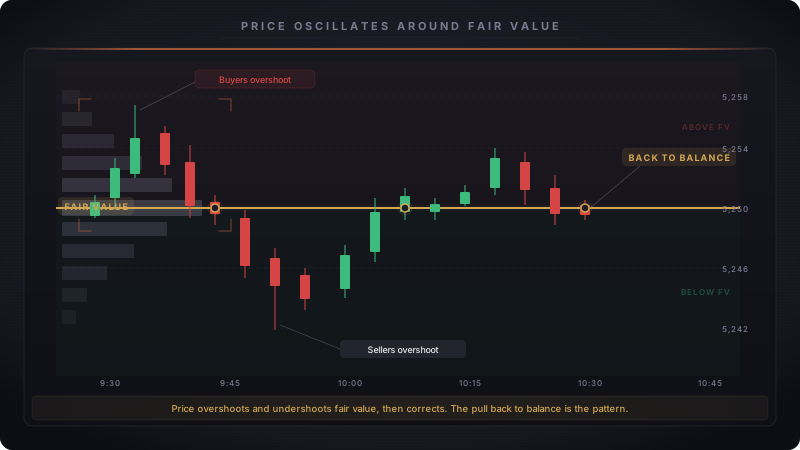
This concept matters more than you think right now. There's a reason price keeps getting pulled back to the same level: that's where the most trading happened. The volume clusters there. In "Volume: The Market's Footprint" (Lesson 8), you'll learn to read volume at price and see exactly where fair value sits on your chart.
But even without those tools, you can start watching for it now. When price moves sharply in one direction and then stalls, ask yourself: did fair value shift, or did price just overshoot? That single question will keep you from chasing moves that are about to reverse.
Every lesson in this module builds on what you just learned. You don't need to memorize definitions. You need to internalize a different way of seeing your chart: as a negotiation, not a prediction game. Now that you understand price as a negotiation between buyers and sellers, the next lesson covers who those buyers and sellers actually are, and the infrastructure that makes the whole system work.