What a Breakout Actually Is
In Lesson 2, you learned that support and resistance are zones where price repeatedly reacts. Buyers step in at support. Sellers step in at resistance. These levels hold until they don't.
A breakout happens when price moves decisively beyond a level that previously contained it. That word "decisively" is doing all the work. A wick poking through resistance by two ticks and snapping back isn't a breakout. A single candle that briefly trades above the level before closing below it isn't a breakout either. Those are tests, and they happen all the time.
Think of breakouts like fire alarms. When the alarm goes off, your instinct says "react now." Evacuate. Move. But experienced building managers know that most fire alarms are false alarms. Someone burned toast. Maintenance triggered a test. A sensor glitched. They've learned to check for actual smoke before reacting.
Breakouts work the same way. Price crossing a level is the alarm going off. The smoke? That's the confirmation evidence: volume, close position, and the retest. No smoke, no fire.
In trading terms: the break is the alarm, and the confirmation evidence is the smoke. Check for smoke before you react.
This connects to the foundational principle from Lesson 1: candlestick patterns describe past buyer/seller pressure, not future direction, and location determines whether a signal is meaningful or noise. A breakout without confirmation is noise at a critical location.
The Fakeout: Why Most Breakouts Fail
Most beginners think a breakout means price will keep going. They see price cross a level and assume momentum will carry it forward. This mental model feels right because when you look at historical charts, the big moves always started with a breakout. But that's survivorship bias. You're seeing the breakouts that worked and forgetting the dozens that failed for every one that succeeded.
Your brain reinforces this without you noticing: when you scroll through a chart, the breakouts that led to big moves jump out visually while the failures blend into normal price noise. Your mental database of "what breakouts look like" becomes skewed toward winners, making every new breakout feel like the start of something big.
Why do fakeouts happen so often? It doesn't take much to push price through a level temporarily. A small cluster of stop-loss orders sitting above resistance can trigger a cascade: price hits the stops, the stops fire as buy orders, those buys push price a bit higher, and it looks like a breakout.
But once those stops are filled, there are no new buyers to sustain the move. Price stalls, reverses, and drops back below the level. Everyone who bought the "breakout" is now underwater.
Trading breakouts aggressively is one of the fastest ways to drain an account. You're entering at the worst possible location: right at the level, where risk is highest and confirmation is weakest. The traders who profit from breakouts aren't the ones jumping in first. They're the ones waiting for proof.
Volume: The Breakout's Lie Detector
In Lesson 5, you saw how false breakouts look different from real ones when chart patterns resolve. If you revisit that lesson's breakout comparison diagram, you'll notice the same dynamic we're building on here: the real breakout had follow-through, the fake one didn't. Now here's the tool that helps you identify which type you're watching as it happens: volume.
A real breakout has participation behind it. Lots of traders are getting involved. Sellers who were defending the level have given up or been overwhelmed. New buyers are flooding in. You see this as a volume spike on the break candle: volume that's clearly above the recent average.
A fakeout has the opposite volume signature. Price crosses the level, but volume stays flat or even drops. The market is telling you "almost nobody is participating in this move." The few orders that pushed price through aren't being followed by conviction.
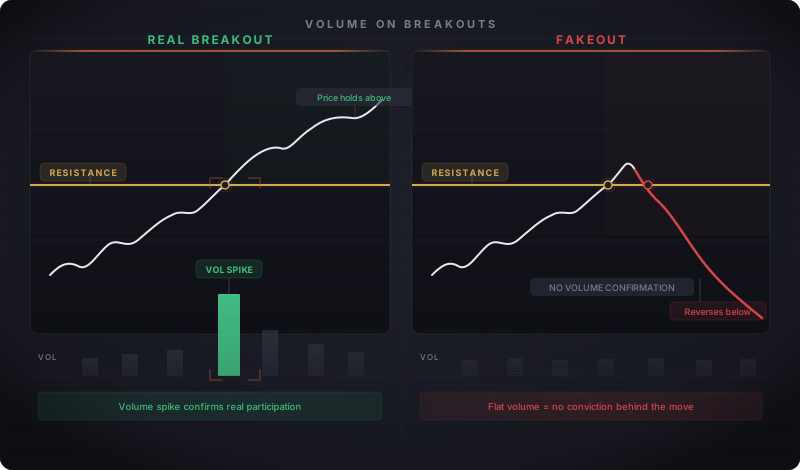
Volume isn't a guarantee. Some fakeouts happen on decent volume, and some real breakouts start quietly. But when you combine volume with candle close position, your ability to filter the real moves from the traps improves significantly.
The Retest: Your Second Chance
This is the part most traders miss: you don't have to enter on the breakout itself.
After a real breakout, price often pulls back to the level it just broke through. Remember the support-resistance flip from Lesson 2? Once price breaks above resistance, that former resistance becomes the new floor. The pullback to test this new floor is called a retest.
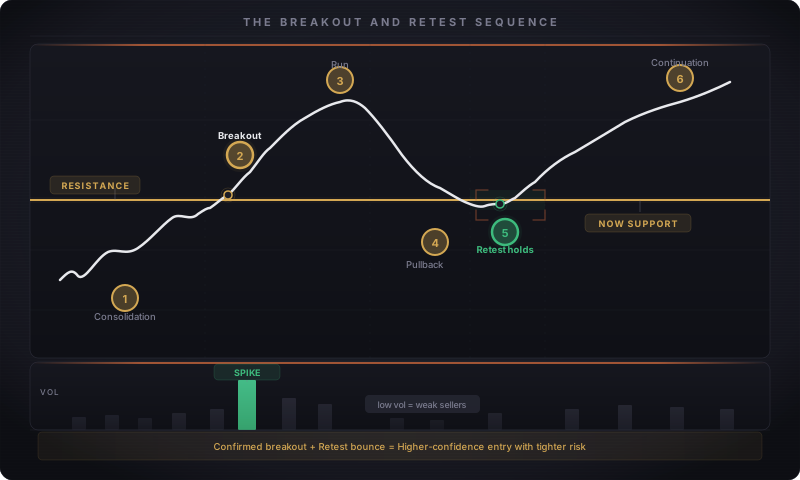
The retest is a safer entry than the breakout for three reasons. First, you've already seen confirmation: price broke the level, held beyond it, and is now coming back to test. Second, your stop placement is tighter. Instead of guessing where to put your stop during the initial chaos of the break, you place it just below the retested level. Third, if the retest fails and price drops back through the level, you've gotten the cheapest lesson possible. You know it was a fakeout, and you're out with a small loss instead of the bigger one from chasing the initial break.
You enter ES long at 5080 as price breaks resistance at 5075. Your stop goes below the range at 5070. Risk = 10 points x $50/point = $500 per contract.
You wait. Price pulls back to 5076, bounces off old resistance (now support), and you enter. Your stop goes just below the level at 5073. Risk = 3 points x $50/point = $150 per contract.
Target for both: 5095. Breakout entry reward = 15 points ($750). Retest entry reward = 19 points ($950).
The breakout entry risks $500 to make $750 (1.5:1 reward-to-risk). The retest entry risks $150 to make $950 (6.3:1 reward-to-risk). Same trade idea, same target, same contract. The only difference is patience.
Putting It Together: When to Trade a Breakout
You now have three lenses for evaluating a breakout: the candle close, the volume, and the retest. Here's how they combine.
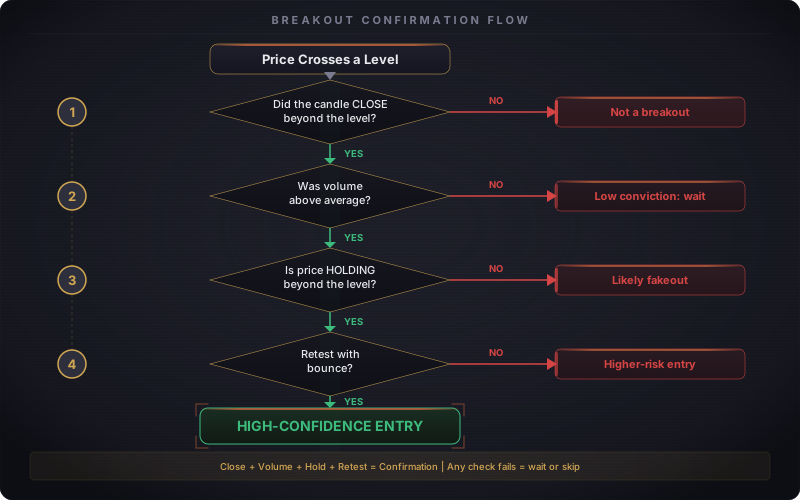
Step 1: Did the candle close beyond the level? If only a wick crossed, it's not a breakout. Move on.
Step 2: Was volume above average on the break? Compare to recent candles in the same session. If volume was flat or declining, be skeptical.
Step 3: Is price holding beyond the level? Watch the next 2-3 candles. If they close beyond the level, even if they're small, the side that broke through is maintaining control.
Step 4: Is there a retest? If price pulls back to the broken level on light volume and bounces, that's your cleanest entry. If the pullback punches right back through, the breakout failed.
Not every confirmed breakout gives you all four. Sometimes you get a clean close, strong volume, and immediate continuation with no retest. That's fine. You don't have to trade it. The retest is your highest-confidence entry, and if it doesn't come, the market wasn't offering you this particular trade.
The lesson from Lesson 4 on trend structure applies here too. Confirmed breakouts often mark the structural shifts, higher highs or lower lows, that define trend changes. When a breakout changes the structure, it carries more weight than one happening within an existing range.
Now that you can tell when a breakout is real versus a trap, the next lesson covers what happens after the break: pullbacks and retests in more depth, including how to size entries on retests and where things go wrong when the pullback extends further than expected.