Two Points Don't Make a Trendline
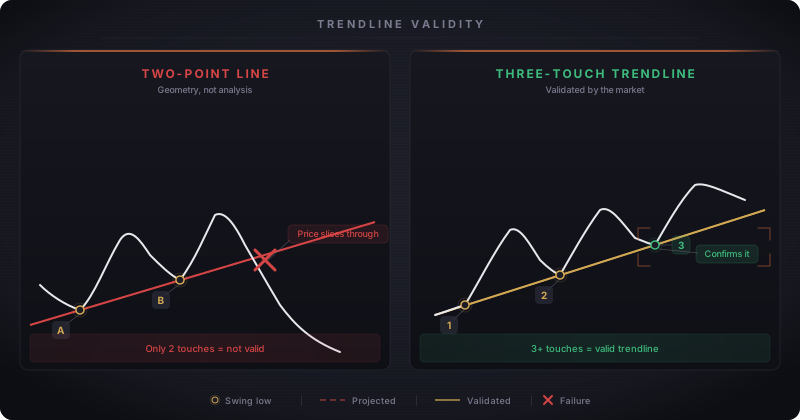
Here's the most common mistake new chart readers make: they find two swing lows, draw a line between them, and treat it like a wall. The problem? Two points ALWAYS make a line. Grab any chart, pick any two low points, and you'll get a perfectly straight line every time. That doesn't mean the market cares about it.
Most beginners think that connecting two swing points creates a valid trendline. It feels right because the line looks clean and the chart suddenly seems organized. But a two-point line is just geometry, not analysis. The market hasn't confirmed anything yet. A trendline only becomes meaningful after a third touch, where price comes back to the line and bounces.
That third touch is proof that buyers (for an ascending trendline) or sellers (for a descending one) are consistently showing up at that price level. Think of it like a footpath through a field. If one person walks across, you've got a single trail that could go anywhere. If a second person walks a similar route, you might have a coincidence. But when a third, fourth, and fifth person all follow the same path, you've got a real trail that tells you something about how people move through that space. Trendlines work the same way. Each touch is another person walking the path. Two touches might be coincidence. Three starts to mean something.
Drawing Trendlines That Mean Something
To draw an ascending trendline, connect at least three swing lows. A swing low is a point where price dropped, reversed, and moved higher. Your line should pass through either the lows of the candle bodies or the tips of the wicks, but pick one method and stay consistent. Mixing body connections and wick connections on the same trendline gives you a fuzzy line that doesn't represent a real level.
For a descending trendline, connect at least three swing highs: the points where price peaked and turned back down. Same rules. Consistent connection points, minimum three touches.
Which method is better, bodies or wicks? Neither one is objectively correct. Body connections give you a tighter, more conservative line that catches the price where most traders settled. Wick connections capture the extremes, showing where aggressive orders pushed before getting absorbed. Some traders draw both and use the space between them as a zone, similar to how you learned to treat S/R as zones rather than exact lines in Lesson 2. The key isn't which method you choose. It's that you stay consistent within each trendline.
Channels: Trading Between Two Lines
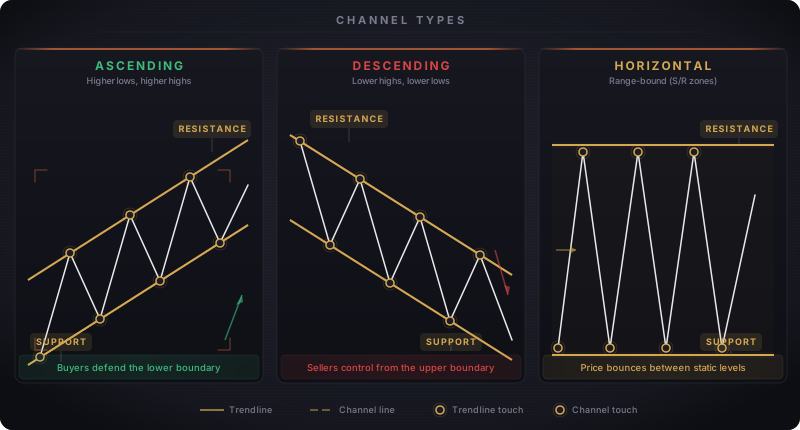
A channel appears when price respects both a trendline AND a parallel line on the opposite side. The trendline defines one boundary, and the parallel line (called the channel line) defines the other. Together, they frame the range where price is moving.
Three types of channels show up in practice:
Ascending channel: higher lows along the trendline, higher highs along the channel line. The market is trending up within defined boundaries. Buyers step in at the trendline, sellers step in at the channel line, and the whole structure drifts higher.
Descending channel: lower highs along the trendline, lower lows along the channel line. The mirror image. Sellers control the direction, buyers provide temporary bounces at the lower boundary.
Horizontal channel: flat trendline, flat channel line. This is what most people call a range. Price bounces between static support and resistance. You already studied this in "Support and Resistance" (Lesson 2) as S/R zones. A horizontal channel is the same concept, just framed with parallel lines instead of individual levels.
The width of a channel matters. A narrow channel means tight, controlled price action with small swings between boundaries. A wide channel means big moves within the trend, giving more room for price to breathe but also more room for your stop to get hit. Channel width directly affects how you think about stop placement and profit targets, something you'll work through in later modules when you build trade plans.
In "Support and Resistance" (Lesson 2), you learned that levels gain strength with more tests but also lose order depth with each touch. Channel boundaries work the same way. Each bounce adds credibility, but each test absorbs some of the orders sitting at that level. After enough tests, the boundary can weaken and eventually break.
When Trendlines Bend vs When They Break
Not every violation of a trendline is a break. Price regularly overshoots trendlines by a few ticks before snapping back. The difference between a false break and a real break comes down to one thing: the close.
A wick that pokes through a trendline but closes back on the correct side is called a false break (or wick violation). It means the trendline held. Buyers on an ascending trendline were waiting on the other side and pushed price back before the candle finished. False breaks are actually confirming signals: they show that demand is still present at the line, even when price briefly traded through it.
A real break is when a candle closes on the wrong side of the trendline. A close below an ascending trendline or above a descending trendline means the balance of buyers and sellers has shifted. The trend may be over.
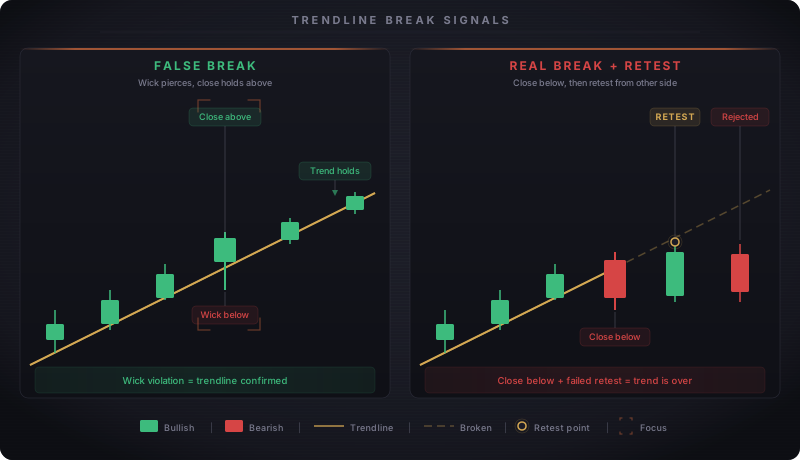
Even after a legitimate break, the story isn't always over. Broken trendlines often get retested. Price breaks below the ascending trendline, pulls back up to the line from the other side, then continues lower. That retest is a high-value signal because it confirms the old trendline is now acting as resistance. This is the same S/R flip mechanism you learned in Lesson 2, just applied to a diagonal level instead of a horizontal one.
The other thing to watch for is bending. Sometimes a trend doesn't break cleanly. Instead, it decelerates. The angle of the trendline flattens, touches get further apart, and price starts spending more time near the line instead of bouncing sharply off it. A bending trend is weakening, and it often precedes a break. But bending isn't breaking. Deceleration means traders are stepping back from the trend, not reversing it. Knowing the difference keeps you from exiting too early on a trend that still has life in it, or holding too long on one that's fading.
Trendlines as Context
In "Candlestick Patterns That Actually Matter" (Lesson 1), you learned that a hammer candle at a key level is a signal, but a hammer in the middle of nowhere is noise. A trendline IS a key level. It just happens to be diagonal instead of horizontal.
When you see a candlestick pattern (pin bar, engulfing, inside bar) at a trendline, that's context stacking. The pattern tells you there was a shift in pressure. The trendline tells you WHERE that shift happened. One without the other is incomplete. Together, they form a much higher-confidence read.
The same applies to trendline and S/R intersections. When a trendline crosses a horizontal support or resistance level, you've got a confluence zone: two independent pieces of evidence pointing to the same price area. These are the spots on the chart where reaction probability is highest, because two separate groups of orders are clustered at the same price.
Now that you can draw trendlines and identify channels, the next lesson covers trend structure: the pattern of higher highs and higher lows (or lower highs and lower lows) that defines whether a trend is intact. Trendlines show you the angle. Trend structure shows you the skeleton underneath.