Why One Timeframe Isn't Enough
Trading on a single timeframe is like using Google Maps zoomed all the way in. You can see the intersection you're at, the lane you need, maybe the next turn. But you have no idea whether you're five minutes from your destination or driving into a dead end. Pinch to zoom out, and suddenly the whole route appears. Now you know where you're going AND where to turn next. Multi-timeframe analysis works the same way: the higher timeframe zooms out to show you direction, and the lower timeframe zooms in to show you exactly where to act.
Most beginners open a 5-minute chart, find a pattern they learned in Lessons 5 and 6, and enter. The pattern might be technically perfect. A clean bullish flag, a textbook pullback to support. But if the daily chart is in a downtrend, that 5-minute long entry is swimming upstream. The pattern isn't wrong. It's irrelevant at that moment, because the dominant flow is moving against it.
The misconception that keeps traders stuck is thinking the lower timeframe is more accurate because it shows more detail. This feels logical because in almost every other domain, more granularity means more precision. A higher-resolution photo IS sharper. A more detailed spreadsheet IS more accurate. Your brain is trained to equate detail with truth. But markets don't work like spreadsheets. At lower timeframes, the noise-to-signal ratio explodes. A 1-minute chart shows every micro-wobble, every stop hunt, every algorithmic ping-pong. It looks chaotic because it IS chaotic at that resolution.
The daily chart filters out that noise and shows the dominant flow. Neither timeframe is more "accurate." They answer different questions. The higher timeframe answers "which direction?" The lower timeframe answers "where, specifically, do I enter?"
And on the other end: some traders keep six charts open, flipping between monthly, weekly, daily, 4-hour, 1-hour, and 5-minute views. Every additional timeframe adds another opinion. At some point, you're not analyzing. You're searching for the one chart that agrees with what you already want to do.
This trap is especially sticky because it disguises itself as thoroughness. You feel disciplined and responsible checking more data. In reality, each additional timeframe just gives your confirmation bias another chance to find what it's looking for. Two timeframes is enough. Three at most.
The Top-Down Workflow
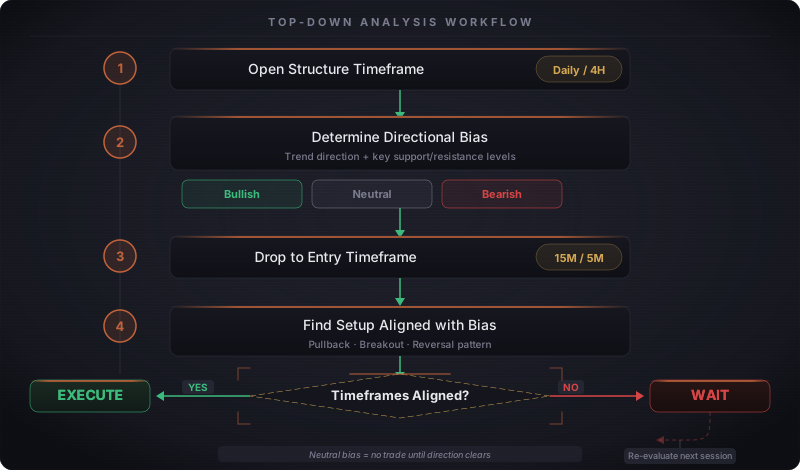
The rule is simple: always start with the higher timeframe. Determine your directional bias first, then drop down to find entries that align. Never start low and work up. If you open the 5-minute chart first and then check the daily for "confirmation," you've got the process backward. You'll see what you want to see on the higher timeframe instead of letting it tell you what's actually happening.
For day trading futures, the standard structure uses two timeframes.
Your structure timeframe is the daily or 4-hour chart. This is where you answer the big question: which direction is the market moving? Is it making higher highs and higher lows (Lesson 4)? Sitting at a key support or resistance level (Lesson 2)? Ranging sideways with no clear direction? The answer becomes your bias: bullish, bearish, or neutral.
Your entry timeframe is the 15-minute or 5-minute chart. This is where you find specific setups: a pullback to a flipped level (Lesson 9), a breakout with volume confirmation (Lesson 8), or a reversal pattern at a key zone (Lesson 6). The critical filter is that the setup must point in the same direction as your structure timeframe bias.
What Alignment Looks Like
Timeframe alignment means the higher timeframe and the lower timeframe are pointing the same direction. In practice, it looks like this.
The daily chart shows a steady uptrend. Higher highs, higher lows, price above the 50-period moving average (Lesson 7). Your bias is bullish. You drop to the 15-minute chart and see price pulling back toward a level that was previous resistance and is now acting as support. Small-bodied candles, declining volume on the pullback (Lesson 9). That's alignment: the daily says "up," and the 15-minute is handing you a pullback entry within that uptrend.
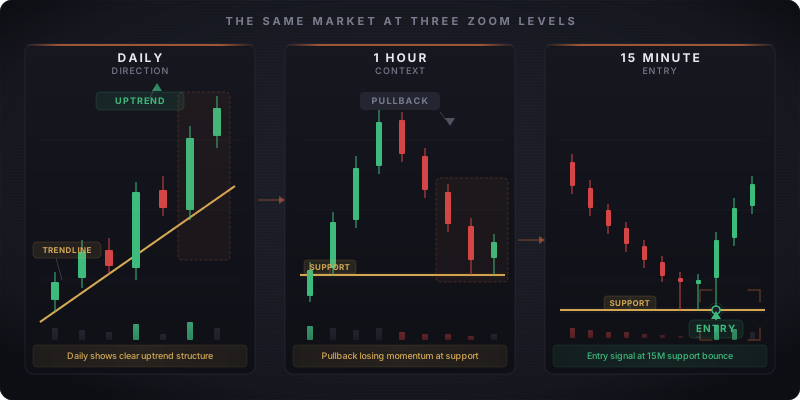
Look at what's happening across those three zoom levels. The daily chart shows a clean trend you can't miss. The 1-hour chart reveals a pullback hidden inside that daily trend. And the 15-minute chart shows the moment price finds support within that pullback, which is the entry point. All three timeframes are telling the same story at different resolutions. That's the setup you're waiting for.
When Timeframes Conflict
The hardest part of multi-timeframe analysis isn't finding aligned setups. It's walking away from lower timeframe setups that look beautiful but fight the higher timeframe trend.
A textbook bullish flag on the 15-minute chart means nothing if the daily is making lower highs. A clean pullback to support doesn't matter if the 4-hour trend is pointing down. The lower timeframe will always show you patterns. That's what charts do at every resolution. Patterns form constantly. But a pattern without directional support from the higher timeframe is missing the one ingredient that shifts the odds in your favor.
This connects back to the Pre-Execution Protocol from Lesson 9: check your size, check your stop, check your bias. The third step, "check bias," doesn't mean check your gut feeling or what you think the market "should" do. Your bias comes from the structure timeframe. If the entry timeframe setup doesn't match that bias, the protocol's answer is clear: no trade. Sitting out when timeframes conflict is how you stay consistently profitable. Traders who take every setup regardless of alignment wonder why the results feel random.
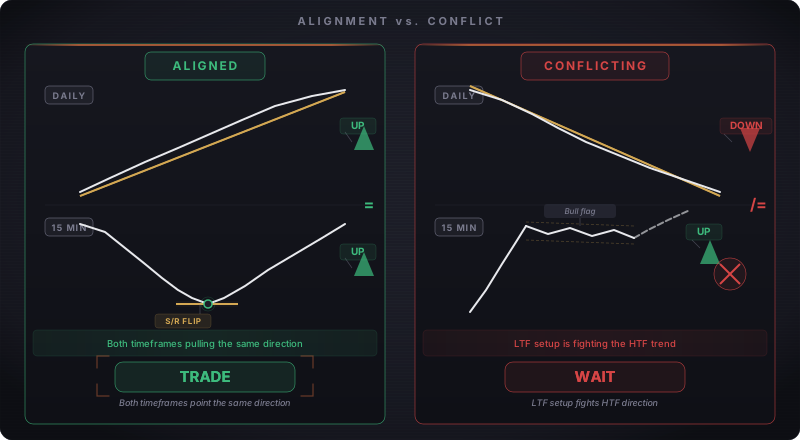
You won't always be right about the higher timeframe's direction. Sometimes a trend reverses, and the setup you skipped would have worked. That's fine. Over a hundred trades, acting only when timeframes align will produce better results than forcing trades when they disagree. Consistency comes from repeating a process, not from chasing every opportunity.
This is the final lesson in Module 1.2, and it's worth pausing to recognize what you've built. Over ten lessons, you've gone from reading individual candle pressure (Lesson 1) through support and resistance, trend structure, chart patterns, moving averages, breakouts, and pullback entries, and now you've combined all nine skills into a single top-down workflow. That's not a small thing. Most traders never develop a structured way to read price action. You just did.
But reading price action and trading profitably are not the same thing. You can identify the perfect setup and still blow up your account with bad sizing or no stop-loss. In Module 1.3: Risk Management Essentials, you'll learn the skill that protects everything you've built: position sizing, stop placement, the 1% rule, and the drawdown math that keeps you in the game when the market tests you. Because knowing where to enter means nothing if you don't know how much to risk.