What Continuation Patterns Actually Tell You
In 'Candlestick Patterns That Actually Matter' (Lesson 1), you learned the principle that drives everything in this module: a pattern without location context is noise. That principle matters here more than anywhere else, because continuation patterns are the patterns traders most often trade on shape alone.
The mechanics are straightforward. The prior trend pushed price hard in one direction. Buyers were winning (in an uptrend) or sellers were winning (in a downtrend). Then the winning side paused. Not because they gave up, but because the other side found a price where they were willing to step in. The result is a temporary standoff: each swing gets smaller, each rally or pullback covers less ground, and the range compresses.
Think of two people arm wrestling. One has been slowly pushing the other's hand down for 30 seconds (that's the trend). Then the losing side digs in, and the hands hover in the middle, barely moving. The winning side is still stronger, probably, but the losing side found a position they can hold. Eventually something gives. Either the stronger side finishes the job, or the losing side finds a burst and flips the advantage. A continuation pattern is that hovering moment on a chart. You're watching to see who folds first.
What separates a meaningful pattern from random compression is whether there's a structural reason for the standoff. A triangle sitting right at a tested resistance level from Lesson 2, where price has bounced twice already, tells you something: buyers are repeatedly showing up at higher prices while sellers defend a level that has held before. That's a story with characters and stakes. The same triangle floating in the middle of an open range, with no key level above or below, has no story. It's just price wandering.
Triangle Patterns: Three Setups, One Mechanism
All three triangle types share the same basic structure: two converging trendlines that contain price as it makes lower highs, higher lows, or both. What differs is which side is doing the squeezing.
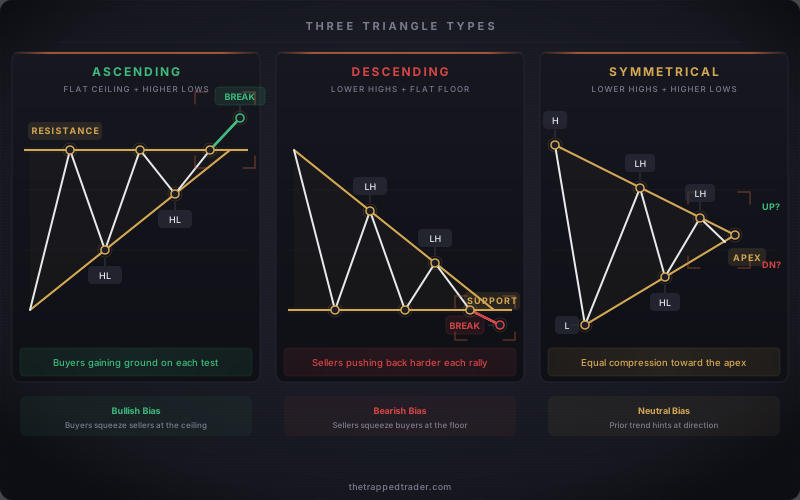
Ascending triangle: The resistance ceiling is flat. Buyers keep making higher lows. Each test of the resistance level is at a slightly higher price, meaning sellers are having to defend that level against increasingly aggressive buyers. The pattern leans bullish because buyers are clearly in control of the lows.
Descending triangle: The support floor is flat. Sellers keep making lower highs. Each rally gets weaker. The pattern leans bearish because sellers are systematically pushing back against every bounce.
Symmetrical triangle: Both trendlines slope toward each other at roughly equal angles. Neither buyers nor sellers have a clear edge on the consolidation. Price compresses toward the apex. Resolution can go either way.
Most beginners look at an ascending triangle and think: bullish bias, trade the upside breakout. That shortcut feels reliable because it works just often enough to keep you using it. Ascending triangles do break upward more often than not in textbook studies.
But those studies don't filter by location. In a live chart, the internal pattern bias and the external location bias don't always agree. If that ascending triangle is forming right at a major resistance level that's been tested eight times on a higher timeframe, sellers are very much in control of that ceiling. The pattern says "buyers are gaining," but the location says "sellers keep winning here." Both things are true, which means neither is a clear edge. Textbooks teach patterns in isolation. Live charts put patterns inside a context that either confirms or contradicts the shape's internal logic.
In Lesson 3, you learned to draw trendlines through pivot highs and lows. Drawing triangle boundaries uses the same skill: connect at least two swing highs for the upper line, two swing lows for the lower line. The line isn't valid until it has two touches. Three touches makes it significant.
Flags and Pennants: The Pause After the Surge
Triangles can take dozens of bars to develop. Flags and pennants are faster. They show up when price makes a sharp, aggressive move, then pauses briefly before deciding whether to keep going.
The pattern has two parts, and both matter. First, a sharp move that covers a lot of ground quickly. Traders call this the flagpole. It's the momentum that sets the stage.
Second, a tight, orderly consolidation where the winning side holds their gains while the market catches its breath. That consolidation is either a flag (price drifts in a parallel channel, usually angled slightly against the trend) or a pennant (price compresses into a small symmetrical triangle that pinches toward an apex).
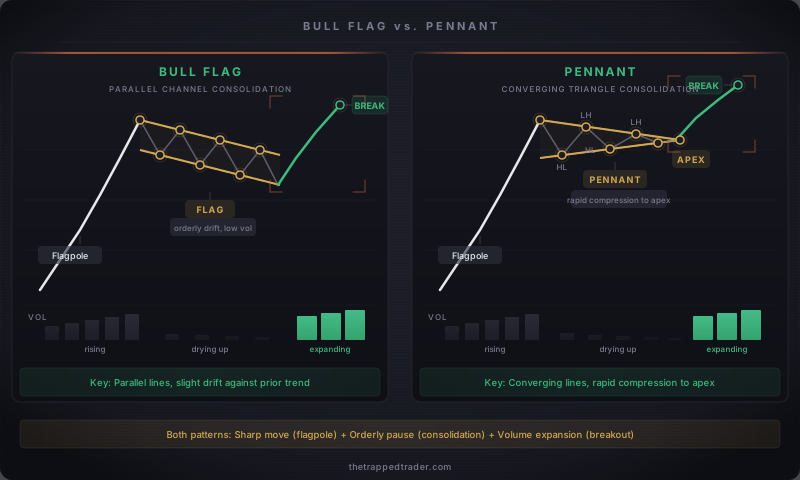
The key to reading flags is volume. Look at the diagram above: during the flagpole, volume is high. Traders are committing. During the consolidation, volume dries up. That's the tell. If volume stays heavy during the pullback, it's not a flag. It's distribution: the winning side is cashing out and the other side is stepping in. But when volume goes quiet, it means the traders who drove the flagpole are still holding. They're not selling. They're waiting.
That distinction, quiet consolidation versus heavy pullback, is what separates a flag worth watching from a random pullback that happens to look like a channel. The shape is secondary. The volume behavior is primary.
A pennant works the same way, but the consolidation compresses into converging lines instead of a parallel channel. Price makes lower highs and higher lows simultaneously, squeezing toward an apex. The volume signature is identical: high on the pole, quiet on the pennant, expanding on the break.
Location: Why the Same Pattern Can Be a Signal or Noise
You can identify every pattern in this lesson perfectly and still lose money consistently if you ignore where those patterns form. Here's why.
A continuation pattern is a record of supply and demand battling at a specific price. When that battle happens at a level where supply and demand have battled before, meaning a support or resistance zone you marked in Lesson 2, you know something about the stakes. Traders are watching that level. Orders are stacked there. The breakout from the pattern has an audience.
When the same pattern forms in the middle of nowhere, there's no audience. No one put significant orders at that price. No one is watching. The compression is random, the breakout has no structural backing, and the follow-through is usually weak.
In 'Support and Resistance' (Lesson 2), you learned to mark the levels where price has visibly reacted before. In 'Trend Structure' (Lesson 4), you learned to identify whether the market is making higher highs and higher lows or lower highs and lower lows. Both of those analyses have to happen before you evaluate any continuation pattern. The checklist is:
- Prior trend is clearly structured. If you can't label the swing highs and lows from Lesson 4, you don't have a trend. No trend means no continuation.
- Pattern forms at a meaningful level. Is the pattern sitting at tested support, at previous resistance, or at the boundary of a range? If you can't name the level, the pattern lacks context.
- Breakout has room to run. If a breakout would immediately slam into the next major level 3 points away, the risk-reward doesn't work. Patterns at the edge of a range, where a breakout opens into clear space, have better structure.
The discipline is doing this analysis before you get excited about the shape. Evaluate the location first, the trend structure second, and the pattern shape last.
False Breakouts: Why Patterns Fail
The most expensive lesson most traders learn from chart patterns is what a false breakout costs them.
Price pushes through the upper boundary of a triangle. It looks like the breakout. You enter long. Price moves up two ticks, stalls, then drops back through the boundary and continues lower. Remember the arm wrestling analogy: one arm slips past center for a moment before getting shoved back. It looked decisive, but it didn't have the sustained force behind it.
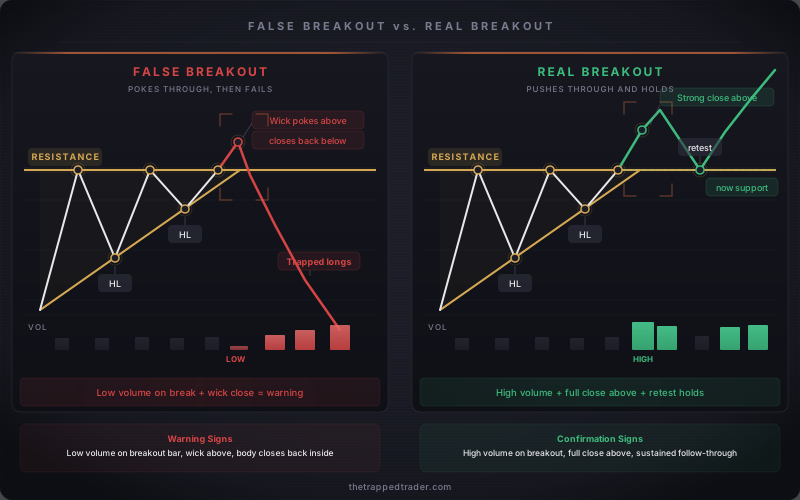
Most false breakouts share a few recognizable features:
Low volume on the initial push. If price breaks through the triangle or flag boundary but the volume on those breakout bars is lighter than the bars during the prior trend, fewer participants are committing to the move. The breakout lacks fuel.
Immediate slowdown after the boundary. Real breakouts tend to keep moving after clearing the level. False breakouts often stall right above (or below) the boundary, leaving a tail on the bar that poked through.
Failure to close on the right side. A bar can wick through a boundary but close back inside the pattern. On a bar-by-bar basis, that's not a breakout. A breakout close, where the entire bar body is on the other side of the boundary, carries more weight.
None of these filters guarantee you catch every false breakout. What they do is shift your entries away from the impulsive, "here it goes!" moment and toward confirmation. Waiting for the bar to close, watching whether volume expands, giving price a few bars to prove it's staying above the level: these habits don't make you miss the trade. They make you miss the trap.
There's a deeper dynamic worth understanding. Pattern boundaries attract orders. Breakout traders stack buy stops above resistance; short sellers stack sell stops below support. Large institutional traders know this, and sometimes price pushes through the boundary specifically to trigger those clustered orders, providing the liquidity needed to fill a position in the opposite direction. The breakout was never genuine. It was a mechanism for filling orders.
This doesn't mean every false breakout is engineered. But understanding that pattern boundaries are liquidity magnets explains why breakouts fail at the same setups repeatedly. Volume remains your best filter: genuine breakouts backed by real commitment look different from quick spikes that trigger stops and reverse.
This is why your stop loss matters more on breakout trades than almost anywhere else. Before you enter, you need to know exactly where the trade is wrong, and you need to accept that cost before entering.
If the breakout fails and price reverses back through the boundary, that's your answer. The pattern didn't work. What you can't do is average down into a failing breakout or hold through the reversal hoping it turns around. A breakout trade is a momentum bet: either momentum is there or it isn't. Adding to a losing breakout position is how a small, defined loss turns into the kind of drawdown that takes weeks to recover from.
The Context Test
Every concept in this lesson points to one discipline: evaluate context before you evaluate the pattern.
You've already built the checklist: confirm the trend (Lesson 4), name the nearest key level (Lesson 2), and verify there's room for the breakout to run. If any of those checks fail, the pattern isn't worth your attention, regardless of how clean it looks.
The remaining filters happen at the breakout itself. Did the bar close on the correct side of the boundary? Did volume expand? These confirmation signals from the false breakout section separate trades worth taking from traps worth avoiding.
The Pre-Execution Protocol ties it together: before acting on any pattern breakout, check your position size, check where your stop goes (below the pattern boundary or the nearest structural level), and check whether your directional bias is backed by the trend structure from Lesson 4. The pattern tells you compression is happening. Context tells you whether that compression matters. They're different questions, and you need answers to both.
Think about the last time you spotted a clean pattern on a chart and felt that pull to trade it immediately. That impulse is the shape talking. The discipline is pausing long enough to ask: does this pattern have a story, or is it just geometry?
A triangle at a level where price has reversed three times in the past month has a story. The same triangle drifting through the middle of a wide range, with no level above or below to give the breakout meaning, is just lines on a screen. The pattern looked identical in both cases. The context made one worth watching and the other worth ignoring.
Now that you can read continuation patterns and evaluate whether they carry meaning, the next lesson covers the opposite: reversal patterns. You'll use the same context-first logic, but you'll be watching for the moment when the winning side loses control.