

Why Position Sizing Breaks Traders (Not Bad Entries)
Most trading content focuses on entries. The perfect setup, the ideal confirmation signal, the exact level to get in. Every YouTube video, every course, every Discord alert: entries, entries, entries.
I bought into that for a long time. Then I went back through hundreds of my own trades in my journal, and the pattern was obvious. My winners and losers didn't sort by entry quality. They sorted by size. The trades where I calculated my position based on defined risk were manageable regardless of outcome. The trades where I sized based on how I felt? Those are the ones that ended accounts.
The research backs this up. The Brinson, Hood, and Beebower study found that 91.5% of portfolio performance variation came from allocation decisions, not individual security selection. That study looked at long-term portfolios, but the principle holds for day trading too: how much you risk on each trade has more impact on your P&L than where you enter.
Here's what conservative sizing actually buys you: 10 consecutive losses at 1% risk per trade is a 9.6% drawdown. Ugly, but survivable. Those same 10 losses at 5% risk? That's a 40% drawdown, and now you need a 67% gain just to get back to even. The math of survival is the math of small size. If you're still building your market fundamentals, the How Markets Work module covers everything from order mechanics to how the spread affects your real cost per trade.
This isn't another position sizing calculator. If you want one, the free position sizing calculator at /tools will run the math for you. This is about building a sizing discipline you'll actually follow when your account is green and your confidence is running hot.
Lock Your Size Before You Click
The rule is simple: calculate your position size before the trade, and don't change it. Not during the trade, not because the setup "looks even better now," not because you're on a winning streak. Lock your size before you click, and keep it locked.
The formula itself takes ten seconds:
Contracts = Account Risk ($) / (Stop Distance in Points x Point Value)
Three numbers. That's all you need. Point value is the dollar amount one full point of price movement is worth, and it's different for every contract.
ES (E-mini S&P 500): Point Value = $50
With a $50,000 account risking 1% ($500) and a 2-point stop:
$500 / (2 x $50) = 5 contracts
Same account, wider 4-point stop:
$500 / (4 x $50) = 2.5, round down to 2 contracts
Wider stop means fewer contracts. The dollar risk stays the same. That's the whole point of the formula.
NQ (E-mini Nasdaq 100): Point Value = $20
Same $50,000 account, 1% risk ($500), 10-point stop:
$500 / (10 x $20) = 2.5, round down to 2 contracts
NQ moves bigger than ES in points, so the stop is wider and the contract count is lower. If you're deciding which contract fits your account, the ES vs NQ guide breaks down the differences.
MES and MNQ (Micro Contracts)
For smaller accounts, micros change the math dramatically. MES has a point value of $5 (one-tenth of ES). MNQ is $2 per point.
A $10,000 account risking 1% ($100) with a 2-point stop on MES:
$100 / (2 x $5) = 10 micro contracts
Same risk, same stop, smaller contract. Micros let you size precisely without the all-or-nothing pressure of minis.
Quick Reference: Contracts at 1% Risk
| Account | 1% Risk | ES (2pt stop) | NQ (10pt stop) | MES (2pt stop) | MNQ (10pt stop) |
|---|---|---|---|---|---|
| $10,000 | $100 | 1 | 0 | 10 | 5 |
| $25,000 | $250 | 2 | 1 | 25 | 12 |
| $50,000 | $500 | 5 | 2 | 50 | 25 |
| $100,000 | $1,000 | 10 | 5 | 100 | 50 |
Point values: ES = $50, NQ = $20, MES = $5, MNQ = $2. Always round down. Accounts under $25K should stick to micros. The mini columns are shown for reference, but at that account size, a single loss at full contract size does too much damage.
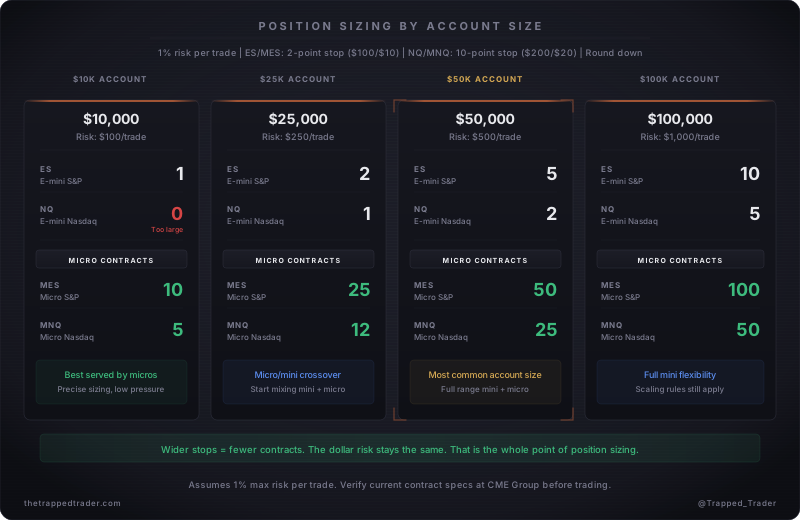
Round down, always. If the math says 2.7 contracts, you trade 2. Rounding up is the first step toward "close enough" thinking, and close enough is how funded accounts die.
Position Sizing for Prop Firm Traders
Prop firms change the math completely. Your account balance says $50,000, but your real constraint is the trailing drawdown, not the balance.
Most prop firm evaluations, whether it's Topstep, Apex Trader Funding, Take Profit Trader, Tradeify, My Funded Futures, or Lucid, give you a drawdown limit that's a fraction of the account size. The specific numbers vary by firm, but the principle is universal: size from the drawdown, not the balance. This is where most evaluation failures start. Traders treat a $50K prop account like a $50K personal account and blow through the drawdown limit in two bad sessions.
Topstep Parameters (as of March 2026)
| Account Size | Max Contracts | Max Loss Limit |
|---|---|---|
| $50,000 | 5 contracts | $2,000 |
| $100,000 | 10 contracts | $3,000 |
| $150,000 | 15 contracts | $4,500 |
Prop firm rules change frequently. Verify current parameters at topstep.com before signing up. Topstep has historically used a trailing drawdown mechanic for their loss limit, but check their current rules documentation for exact details.
A $50K account with a $2,000 trailing drawdown and 5 max contracts? Treat it like a $2,000 account that lets you trade up to 5 contracts. Size accordingly.
Scaling rules are one of the things prop firms actually get right. For traders who struggle with discipline, having a maximum contract limit keeps sizing somewhat in check. But even with those limits, most prop accounts still offer too much leverage for the available drawdown. You can blow through a $2,000 trailing drawdown in a single session trading 5 contracts on ES.
Modified Formula for Evaluations
Instead of using your account balance for the risk calculation, use your trailing drawdown limit:
Contracts = (Drawdown Limit x Risk %) / (Stop Distance in Points x Point Value)
On a $50K Topstep account with $2,000 drawdown, risking 2% of your drawdown ($40) per trade with a 2-point ES stop:
$40 / (2 x $50) = 0.4, meaning you need micro contracts or a wider stop to make the math work
Conservative? Absolutely. But passing an evaluation beats resetting one. I've done enough resets to know.
The Scaling Path: When and How to Size Up
"I can't make money on 1 contract." I hear this constantly. And I get it. One contract on MES at $5 per point feels like you're trading for coffee money. You see traders in Discord posting $2,000 days on 10-lot NQ and you start questioning whether your 2-lot micro discipline is actually building something, or just holding you back.
That comparison will kill your account faster than any bad setup. The traders posting those screenshots aren't showing you the five blown accounts that came before, or the evaluation reset they paid for last week.
The math of consistency beats the math of size every time. One contract traded well for 6 months builds something you can scale. Five contracts traded recklessly for 6 months builds nothing but a history of resets and blown accounts.
Small consistent gains beat home runs because they compound and they survive. You can't compound what you've blown up.
Scaling Criteria (Not Feelings)
You earn the right to add size when:
-
Three consecutive profitable months at your current contract size. Not three good weeks. Three months. This proves your edge works at this size through different market conditions.
-
Increase by one contract (or 25% of your current size, whichever is smaller). Going from 2 to 3 contracts is a 50% increase in exposure. That's enough.
-
Drop back immediately at the first losing month after sizing up. No questions, no "let me see if next week turns around." Back to the previous size until you rebuild the three-month streak.
This process isn't exciting. That's the point. Sizing up should feel boring and procedural, not emotional and spontaneous. If you're sizing up because you feel confident, you're doing it wrong. Confidence is not a criterion.
And when you have to drop back? That feels awful. Going from 3 contracts back to 2 feels like regression. Like admitting you can't handle size. Like going backward while everyone else seems to be moving forward. Sit with that feeling, because it's the exact emotional trigger that makes traders skip the drop-back step and blow up instead. Sizing down keeps you in the game long enough to size up again. That's the only thing that matters.
The Micro-to-Mini Transition
If you're trading micros and want to move to minis, treat it like learning a new instrument. The P&L swings are 10x larger. One point on MES is $5. One point on ES is $50. That difference hits differently when you're watching it in real time.
Start with one mini contract. Trade it for a full month alongside your regular micro size. See how the larger swings affect your decision-making before committing. Pairing this transition with a solid understanding of timeframes and what they mean helps you read the larger swings without panicking.
Why You Keep Breaking Your Own Sizing Rules
You already know the formula. The math takes ten seconds. So why do you keep oversizing?
Because futures position sizing isn't a math problem. It's a discipline problem. And the psychology working against you is well documented.
The Overconfidence Cycle
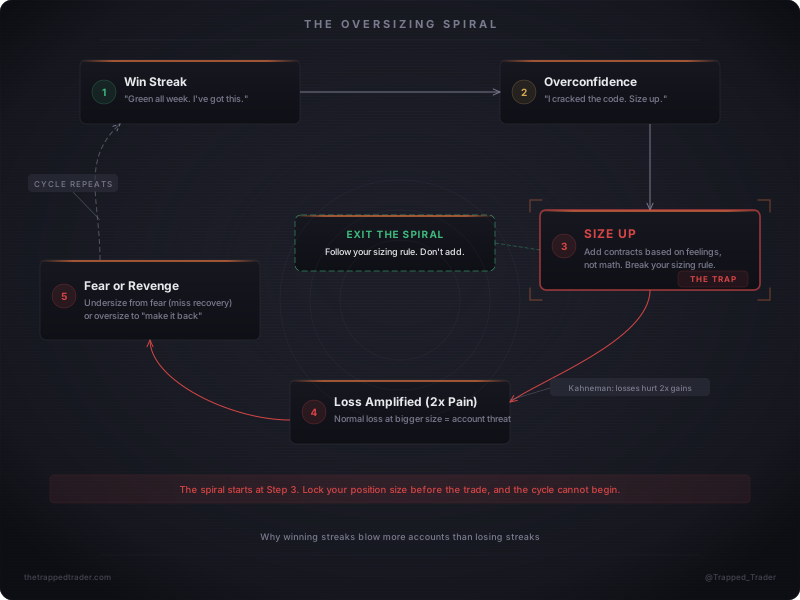
You know the feeling. Three green days in a row, your sizing rule says 2 contracts, but the little voice says "you've earned 3." You haven't earned anything. Your feelings changed, not your edge. But in that moment, the rule feels small and the opportunity feels big. So you bump it up. "Just this once."
There's research behind why this happens. Kahneman and Tversky's work on prospect theory showed that losses feel roughly twice as painful as equivalent gains feel good (the accepted range is 1.5x to 2.5x). So after a winning streak, the pleasure of those gains inflates your confidence. And when the inevitable loss comes at that larger size, it hits twice as hard emotionally, because you've just magnified it with extra contracts.
The opposite trap is just as destructive. After a string of losses, fear takes over and you start undersizing. One micro contract when you should be trading five. Your winners barely move the needle, frustration builds, and eventually you oversize to "make up for lost time." Same cycle, different entry point.
This is exactly why The Drawdown Protocol exists. When you hit 50% of your daily risk limit, cut your size in half. When you hit 100%, you're done for the day. Screen off, walk away. No "one more trade to get it back."
Say your daily risk limit is $500. You take two losses totaling $250, that's 50%, so you cut from 3 contracts to 1. You take another loss and hit $500, you're done. No renegotiating. No "the market just turned, one more." That rule doesn't just protect your capital, it breaks the emotional spiral before it starts. Without a hard cutoff, the overconfidence cycle and the revenge cycle feed each other until there's nothing left to trade.
How One Trade Kills a Funded Account
Here's how it plays out. A trader on a $50K evaluation has a plan: 2 contracts on ES, 2-point stop, $200 risk. Clean setup. They've been green for two weeks and feel sharp, like they've figured the market out.
The trade goes against them by a point. Instead of taking the stop, they add 2 more contracts, averaging down. Now they're in for 4 contracts with no defined stop, waiting for a bounce that isn't coming.
The market moves another 5 points against them. In about 20 minutes, a planned $200 loss turns into $1,200. Two weeks of grinding small gains, gone on one trade. The evaluation is over. Back to the application, back to the fee, back to square one.
I've lived this exact pattern. Different accounts, different setups, same result. I've 5X'd my size on NQ after a green streak because I "knew" the next one would hit. It didn't. Averaging down is what kills funded accounts. Not the setup, not the direction, not the market. Breaking your own sizing rules and adding contracts based on hope instead of math.
The Recovery Math
Oversizing is destructive because losses don't recover symmetrically.
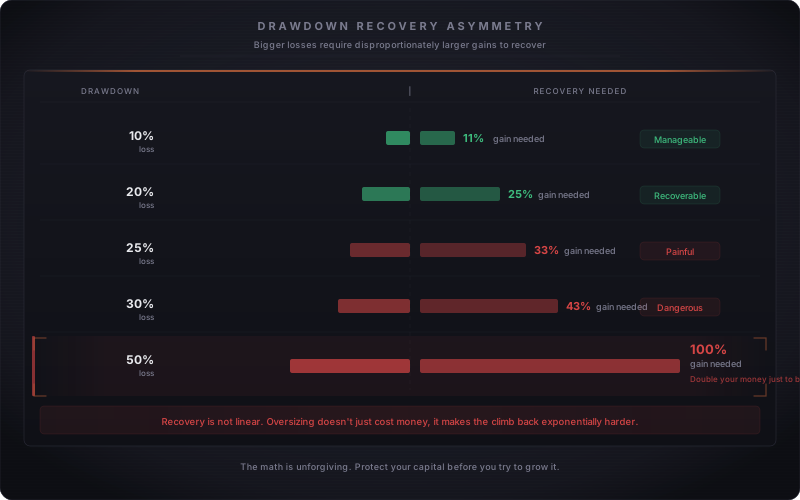
A 10% drawdown needs an 11% gain to recover. Uncomfortable but doable. A 25% drawdown needs a 33% gain. A 50% drawdown needs a 100% gain: you have to double your remaining balance just to get back to where you started.
That's not just math. That's the feeling of being in a hole that gets deeper every time you try to climb out. Every oversized loss doesn't just cost you money, it buries you under a recovery target that gets exponentially harder to reach. And the deeper you go, the more desperately you trade, which digs the hole deeper. If you've been through the losing streak cycle, you know exactly how this spiral feels. The answer starts with sizing down, not trading harder. The mindset hub goes deeper on the psychological patterns that keep traders stuck in this loop.
How to Actually Lock Your Size
Knowing the right size and trading the right size are two different skills. The first is math. The second is discipline. And discipline needs structure, not willpower.
Write your calculated position size on a sticky note before the session starts. Put it where you can see it. When you open the order entry, check the note before you type the number. If the number in the box doesn't match the number on the note, you don't click.
Some traders use a pre-trade checklist in their journal. Others set alerts in their platform. UpSkalr handles the math for you based on your account type and size, and the algorithm manages your scaling so you don't have to fight yourself on it. You can track your trades, journal them, and see exactly where your sizing discipline held up or broke down. However you do it, the principle is the same: put a physical step between the impulse to size up and the ability to act on it. The harder you make it to break the rule in the moment, the more likely you are to follow it when your ego starts whispering.
Position sizing is where most blown accounts actually happen. Not at the entry. Not at the exit. At the moment you decide how many contracts to trade, and you pick a number based on feelings instead of math.
