

The Trap Isn't on the Chart
Most traders think their problem is entries, indicators, or timing. Some blame market makers. I blamed all of those at various points over the years.
Your biggest problem in trading is you. Your mindset, your habits, the emotional patterns that run in the background of every decision you make.
I spent over $100,000 learning this the hard way. I've blown close to 800 prop firm accounts. I've sat at my desk at 9 PM firing off revenge trades on NQ because I couldn't accept that the day was over. I've 5X'd my position size after a loss because my ego couldn't handle being wrong. I told myself "one more contract" so many times it became a reflex.
Every restart began with the same optimism. Every blowup ended with the same frustration. The strategy was never the real problem. I was.
Here's how the cycle actually works. You fund an account, maybe several at once, trade well for a few days, maybe a week. Then one loss hits differently. Maybe the market ran your stop by two ticks. Maybe you missed a move and now you're chasing. That first bad decision leads to a second, slightly bigger one. By the end of the session, you've blown all your accounts, staring at a screen wondering how you got here again.
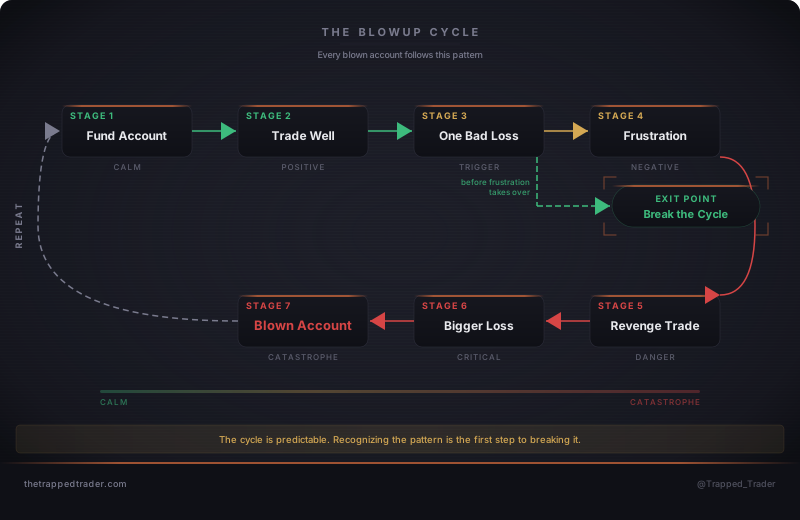
The scariest part? Each step feels rational in the moment. You might feel like you deserve to win. Moving your stop "just a few more ticks" feels like giving the trade room. Adding to a loser feels like averaging down to a better price. Doubling size after a win feels like pressing your edge. The justification is always reasonable. The result is always the same.
The warning signs are predictable: adding to a losing trade to "get back to break-even," taking a setup you know isn't in your plan because someone on X or in Discord just called it, ignoring your stop because you're convinced it'll turn around. How many times have you told yourself "never again" and meant it?
And the traps are worse now than they've ever been:
- Social media dopamine hits every time someone else posts a green P&L screenshot
- Always-on temptation from mobile apps and price alerts that follow you everywhere
- Information overload from dozens of contradicting "must-watch" sources
- 24/7 markets that never let you mentally reset
- The comparison trap of curated highlight reels where nobody posts their blown accounts
That's what this place is for. Not more indicators. Not another signal service. The part of trading that actually breaks people.
What Makes This Trading Psychology Education Different
I'm not going to pretend I have a proprietary indicator or a secret strategy. I don't.
What I do have is a framework built from years of getting it wrong, and then eventually getting it right. Everything at The Trapped Trader rests on two pillars:
Pillar 1: Data-Driven Market Skills
Reading price action and order flow, volume profiles, liquidity mapping, VWAP, options exposure. These are the skills and tools that show where the market is actually accepting value, not where you hope it's going.
The How Markets Work module builds this foundation from scratch. It starts with what a market actually is and works up through price charts, volume, and trading sessions. No prerequisites, no assumed knowledge. If you're new to trading or just need a reset, this is where you start.
Pillar 2: Psychology Training for the Modern Trader
Rewiring the subconscious habits that pull you into bad trades. Spotting tilt signals before they snowball into blown accounts. Building emotional resilience for a market that never sleeps and algorithms that don't care about your feelings.
Most trading education skips this entirely, or buries it in a single chapter with advice like "just be disciplined." Discipline without structure is just willpower, and willpower runs out. The Mindset Hub is where the psychology training lives, and I'm building out a full trading psychology curriculum right now.
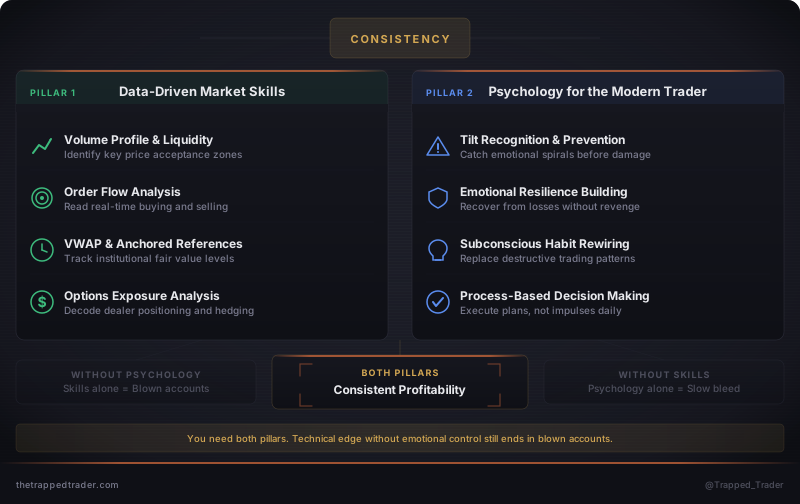
You can't have consistency with only one pillar. A trader with great analysis and no emotional control will blow up. A trader with iron discipline but no market edge will bleed slowly. You need both.
Everything here is built around one principle: process over P&L. I don't care if you had a green day. I care if you followed your rules. A $500 loss where you executed your plan perfectly is worth more than a $1,000 win from a revenge trade that happened to work. That winning revenge trade is the most dangerous outcome in trading, because it teaches your brain that breaking rules pays off.
You know how that story ends, right?
The other framework I keep coming back to is The Drawdown Protocol. Before you sit down, you decide your max loss for the day. Hit 50% of it? Cut your size in half. Hit 100%? You're done. Close the platform, walk away. That number has to be set when your head is clear, not after you're already three trades deep in a hole.
Here's what this place is not:
- No P&L screenshots or "I made $X in Y days" claims
- No signal service or Discord call-outs
- No guru positioning or "follow my trades"
- No motivation speeches without mechanics behind them
Maybe that stuff works for some people. It didn't work for me, and if you're here, it probably hasn't worked for you either. If you want to understand why you keep making the same mistakes and how to build a process that actually holds when real money is on the line, you're in the right place.
What You'll Find Here
The Trapped Trader is the content brand for UpSkalr, and it's built around one goal: helping you escape the blowup cycle and build real consistency.
Structured Courses (Level 1 Is Free)
A full curriculum starting from the ground up. Level 1: Foundations covers how markets work, reading price action, position sizing, trading psychology, and taking your first structured trades in simulation. Five modules, 40+ lessons, quizzes, and hands-on exercises. No login required for Level 1. The content is text-first with inline diagrams, built to actually teach, not just to look impressive on a sales page.
Levels 2 through 4 cover instrument-specific training (futures, options, stocks), methodology deep-dives (including ICT, Wyckoff, Volume Profile, and Order Flow), and advanced topics like systematic trading and running trading as a business. These are in active development.
The Blog
Psychology breakdowns, strategy frameworks, and honest lessons from the trading desk. Posts like why small gains beat home run hunting and how to stop hesitating on entries. New articles regularly.
The Mindset Hub
A dedicated section for the mental side of trading. Revenge trading, tilt, FOMO, the knowing-doing gap. If you already know what you should be doing but can't make yourself do it, start here.
The Weekly Newsletter
The Trader's Debrief lands in your inbox every week. Setups, psychology insights, and market recaps you can read in minutes. No fluff, no upsells.
Your First Move
Pick the path that matches where you are right now.
"I keep blowing accounts and I don't know why." Read the revenge trading guide. The blowup cycle is more predictable than you think. Then come back and work through Level 1.
"I want to learn trading from the ground up." Go straight to Level 1: Foundations. It's free, it's structured, and it starts with how markets actually work before you touch a chart.
"I know what I should do but I can't execute consistently." That's the knowing-doing gap. Start with the trading perfectionism post and the Mindset Hub.
"I'm deciding between ES and NQ." Read the ES vs NQ comparison guide. Tick values, volatility, margin, and which contract fits your style.
"I'm stuck under the PDT rule and can't day trade." Futures don't have the pattern day trader rule. That's one of the biggest reasons traders move to them. Level 1 covers everything you need to make the switch.
"I trade options but I'm drowning in Greeks and complexity." The curriculum covers options too. Start with the fundamentals in Level 1, then move into instrument-specific training when you're ready.
Wherever you start, you don't have to figure this out alone. The Trader's Debrief lands in your inbox every Sunday with one psychology lesson and one framework you can use that week. Follow @Trapped_Trader on X for the daily stuff.
The cycle is real. The trap is real. So is the way out.


